Friday, March 09, 2012

Made For Relationship

Have you ever wanted to resign from the human race? Have you been disappointed, hurt, betrayed just one time too many and said to yourself, "Enough is enough!?" Join the crowd.

I think we've all been there from time to time in our lives because, the truth is, relationships are hard. They're also very much worth it. This is not just my opinion, (even though I'm sure that's good enough for you). The facts back me up on this.

I've been reading a great book by John Ortberg called The Me I Want To Be. In that book he quotes some interesting factoids. Social researcher Robert Putnam is quoted as saying that "The single most common finding from a half-century's research on life satisfaction, not only from the U.S. but around the world, is that happiness is best predicted by the breadth and depth of one's social connections."

This confirms something that I've learned from observation, people who have good, healthy relationships are generally happier and even physically healthier than their lonely counterparts. The reality is that we need each other.

We can define success in many different ways, but researchers at The Journal of Happiness Studies (I'm not making this up) have found that one factor consistently separates quite happy people from less happy people. It's not money, health, security, attractiveness, IQ, or career success. As Ortberg says, "What distinguishes consistently happier people  from less happy people is the presence of rich, deep, joy-producing, life-changing, meaningful relationships."

That being said, how are your relationships?

The sad truth is that most men will only have one or two close personal friends in their lifetime - if at all. Many men live their entire lives without having anyone with whom they can disclose their deepest hurts or greatest victories. Women, on the other hand, tend to be much more relational.

I think Henry David Thoreau had a most insightful moment when he said: "Most men lead lives of quiet desperation and go to the grave with the song still in them." The question is, does it have to be this way? I think not.

One of the growing observations in my ministry is this: God has called us to community. He came to redeem and to restore. Part of that restoration involves community. Jesus consistently called us to love one another, and to make loving relationships a priority in our lives. It begins with having a restored relationship with God, from whom we receive what we need to live in relationship. The New Testament is full of "one anothers." We're called to "bear one another's burdens," "forgive each other," "confess our faults one to another," and many more.

It is the moving from surface relationships to true connectedness that is the challenge. Ortberg is right when he says "Connectedness is not the same thing as knowing many people. People may have many contacts in many networks, but they may not have any friends."

There is a risk involved in this, of course. People are people, and they will let you down. But learning to forgive and try again is all a part of personal growth. The option is isolation - and that is not a good option.

There are some amazing facts out there in relation to the power of relationships. Ortberg states that "People who are socially disconnected are between two and five times more likely to die from any cause than those who have close ties to family, friends, and other relationships. People who have bad health habits like cigarette smoking, overeating, elevated blood pressure, and physical inactivity - but who still remain connected - live longer than people who have great health habits but are disconnected."

So how do we build those healthy relationships?

Look up. Start with God. All worthwhile change begins with God. If this relationship is broken, nothing else will work. When Jesus was asked what was the greatest commandment in the Law He immediately replied: “'Love the Lord your God with all your heart and with all your soul and with all your mind.' This is the first and greatest commandment. And the second is like it: ‘Love your neighbor as yourself.’ All the Law and the Prophets hang on these two commandments.” (Matthew 22:37-40)

Look around. Find those "life-givers" who are around you. Who is it that encourages you? Who loves you and wants the best for you? Who is there for you even after you blow it? Strengthen these relationships.

Look within. Be honest with yourself. Many people have never been still long enough to look at their own lives, their dreams, their fears, their hurts, their passions. We are to deal with the baggage if we are to realize our potential. All of this is best done in community.

Look out. Once you have found what you need, look for someone else who is in need of community. There is no shortage of people who have been deprived of healthy meaningful relationships. You can be part of the solution - believe in somebody. As Emily Kimbrough said, "We all stumble, every one of us. That's why it's a comfort to go hand in hand."

Let me end with a quote from Proverbs 18:1 (The Message): "Loners who care only for themselves spit on the common good."

Related Articles:
The Power of Encouragement
Repacking the baggage of our lives
Are You a People Person?
What Love Language Do You Speak?
Iron Sharpens Iron

Thursday, March 08, 2012

Top Ten Blog Posts

I've been blogging for over five years now and recently did a review of the most popular posts. I thought some might be interested in what topics attracted the most attention over that time. Interestingly, all but one of the top ten came from 2011-12. If you'd like to take the time, I'd appreciate hearing which is your favorite. Feel free to pass on the link to my blog if you find it interesting. 
    Apr 23, 2011
   Feb 10, 2011
 
Jan 14, 2012
 
Apr 19, 2011
 
Jan 23, 2012
 
   Sep 17, 2011

Wednesday, March 07, 2012

The Power of Encouragement

We can probably all list a few people in our lives who have that great quality of being encouragers. They are the ones who we are always glad to see when they walk in the door. On the other hand are the discouragers - those who can suck the life right out of a room. We would all like to be encouragers, but just how is that done?

Start with a positive attitude.
Attitude is a choice. Many people don't believe it, but it's true. You can be a glass half full or a glass half empty kind of person. It's up to you. You may have been raised in a negative environment, but you can learn how to look at the world differently. How does that happen?
  • Make peace with God.
This is the beginning point. If you and God aren't getting along there's a very good reason you're miserable. We were created for relationship, and the very first relationship we were created for was the one we should have with God Himself. He has provided all that we need for peace with God through Jesus Christ. It's a gift; it can't be earned. Peace with God is the first key to good relationships with others.
  • Control your thought life.
Our minds are very much like computers, what goes in is what comes out. Read positive books, listen to uplifting music; as far as possible be around positive people. You will gradually find that your attitude towards life will take a turn for the better.

Practice good will.
Good will is really a commitment to giving other people the benefit of the doubt. We all look at people in one of two ways: either they are friends or enemies. Generally, we also find what we're looking for. If you approach someone assuming that their motives are wrong, it is highly unlikely that we will find a friend. On the other hand, if we assume the best about people until proven otherwise we're likely to be rewarded with good will in return.

Look for the good in people.
Everyone has good qualities, even if they are harder to find in some people than in others. Choose to look for the good in people - and mention it. How do you feel when others speak well of you? Doesn't it make you want to do even better? We all like to get a pat on the back, and we all tend to flourish in a positive environment. As Ralph Waldo Emerson said: "Our chief want is someone who will inspire us to be what we know we could be." 

Practice doing the little things.
It doesn't take much to make a big difference. So often when we think about making changes in our lives we make it a huge daunting challenge. Start small. Smile at everyone you meet; you'll find that it's contagious. More often than not your smile will be returned. Make a commitment that with everyone you talk to today you will make one positive comment. Find something that is deserving of a comment - and say it. Tell the person serving your coffee that they're doing a good job. As Mother Teresa said: “Kind words can be short and easy to speak, but their echoes are truly endless.” Write one encouraging note to someone. Finding a note like this can make all the difference in the world, and may turn someone's day around.

Be others centered.
If you want to be an encourager, spend some time investing in another person. Ask them about their day; their life and their family. Focusing on them will help them to feel important, and everyone needs that. One of the best things we can do for ourselves when we're feeling down is to care for someone else.

Look for good examples.

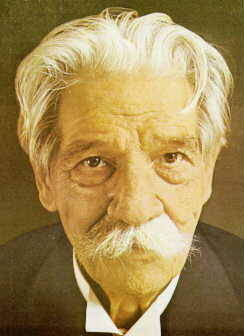
Albert Schweitzer
Who are the people who have encouraged you? What is it about them that stands out? Emulate those qualities. You can become a person that people want to be around. I've included some quotes that speak eloquently to the power of encouragement. We may not be able to change the world, but we can change our corner of it.
"In everyone's life, at some time, our inner fire goes out. It is then burst into flame by an encounter with another human being. We should all be thankful for those people who rekindle the inner spirit." ~ Albert Schweitzer


Booker T. Washington
"Correction does much, but encouragement does more." ~ Johann Wolfgang von Goethe
 
"There are high spots in all of our lives and most of them have come about through encouragement from someone else. I don't care how great, how famous or successful a man or woman may be, each hungers for applause."
~ George Matthew Adams

"There are two ways of exerting one's strength: one is pushing down, the other is pulling up." - Booker T. Washington


Related Articles:


Saturday, March 03, 2012

A Letter to Girls

Some of you may have heard of Paul Gomille, a 17 year old from Ajax, Ontario. Paul's name has been launched into the headlines because he wrote and distributed a letter to the girls in his Catholic High School. He was subsequently suspended by the principal of the school. Here's the letter in full:

"Could I please have your attention for a few moments? I guarantee you won’t regret listening to what I have to say. You definitely won’t regret hearing this in your life time, especially from a man of dignity. It’s an idea that I have held close to my heart even before the kilt controversy arose in the media. This message is not meant to address the kilt controversy directly by any means, but rather, this message is a general and all-encompassing statement. It is a message about the qualities that really matter in a woman, and what really makes a woman attractive. Although this speech has some relevance to the way women dress and present themselves nowadays, the message in this speech goes far beyond one’s preferences, or feelings of pressure, as it relates to the way they dress, and it goes far beyond any concept of modernity. It strikes at the very core of humanity itself, in an attempt to make a revelation of truth apparent to all of you, with awe inspiring certainty. If you read this, and receive anything less than a feeling of absolution from it, then I have committed a grave sin, a sin against myself and a sin against all of you."

"The people this message concerns are the young women of this school, and of the world. In particular, it concerns the silent ones, the intelligent ones, the ones that don’t talk about people behind their backs, the ones that guys don’t flock to in droves, the ones that don’t dress in revealing clothing, the ones who would love to be in love, and the ones that are continually disappointed in their appearance because the only thing they have to compare themselves to are the women that have been put on pedestals by our society. This message also concerns those of you who may consider yourselves the so called “opposite” to the demographic I just described. The ones who do dress in revealing clothing, and the ones who try to fit in with the crowd."

"You don’t need to dress or act a certain way to fit in, to feel attractive, or to BE attractive. You’re all far more attractive than you realize. All of you. But that’s not to say that you should all dress in revealing clothing. No, not at all. Sure, a girl who dresses that way might turn a few heads, and get some compliments. But real attractiveness doesn’t come from wearing the latest fashion, and it doesn’t come from being scantily clad in public, or putting on make-up, or having a pretty face, or a nice body. No. Real attractiveness comes from having a certain dignity. It comes from having class. It comes from being true to yourself, being yourself, and being comfortable in your own skin. This message is for all young women within the sound of my voice and beyond. You’re all beautiful. You all have inner beauty AND outer beauty."

I don't know this kid, and he could have demonstrated a little more humility, but I like what he had to say. I also think it's a message the school should be applauding; not censoring. Austensibly, Paul was suspended for "Opposition to Authority" because he originally asked to give this as a speech to the student body but was denied. The principal asked him to change some parts first because she viewed them as "judgmental," (in bold above). Paul, instead, decided to leave it as is and print and distribute them himself. This was viewed as opposing authority. Charles Adler had some interesting things to say about this on his program.

I don't want to lose the main message in this, however.

Our girls are fed a steady stream of media messages telling them how they need to look and dress in order to be beautiful. Anorexia and bulimia have robbed many young women of their futures as they have tried to force themselves to live up to an unreachable standard. How exactly do you compete with a supermodel who has had every minor physical flaw photoshopped out? And, more importantly, why should you? This is the same message the "Dove Evolution" commercial was trying to say.

There is nothing wrong with trying to look our best. We all do it. But this piece was about self-esteem - feeling good about ourselves and being comfortable in our own skin. I would think that this message would be encouraged in a Catholic School. It reminds me of Proverbs 31:30: "Charm is deceptive, and beauty is fleeting; but a woman who fears the LORD is to be praised."

Our young women are placed in a very difficult position, trying to fit in and be accepted in an often hostile environment. Recognizing that each of us is an individual created by a loving God, we all have value; we all have worth. This is not an appeal to simpler times, but rather to common sense. Many of our young women feel compelled to dress inappropriately in order to gain the attention of the opposite sex, and even to participate in sexual activity before they're ready because they feel it's expected. This is wreaking a lot of damage on this generation of women.

You're right Paul: "Real attractiveness comes from having a certain dignity. It comes from having class. It comes from being true to yourself, being yourself, and being comfortable in your own skin." I do hope that some of the girls are listening. Comments are welcome.

Related Articles:
Minding Our Manners
"Gendercide" - A Deeper Look
Triumph and Tragedy - Whitney Houston
What Love Language Do You Speak?

Thursday, March 01, 2012

When is Killing Your Baby Okay?

I had a hard time just writing the title to this article. It's being written just after I read a piece from The Telegraph titled "Killing babies no different from abortion, experts say." If these "experts" were only making a statement, I would tend to agree, being that I am pro-life and believe that life begins at conception. But that is not what they are saying.

These authors, linked to the prestigious Oxford University, are actually laying out the argument that parents should have the right to have their baby killed after he or she is born  and that this "should be permissible in all the cases where abortion is, including cases where the newborn is not disabled.” Their article was published in the Journal of Medical Ethics.

Sadly, this is not new and I'm not surprised. The ethic espoused here was promoted by Peter Singer and others long ago. In fact, you can trace the philosophical underpinnings of their position back to some of the philosophers of the 19th century. Singer, later of Princeton University, wrote, in 1979, that “Human babies are not born self-aware, or capable of grasping that they exist over time. They are not persons”; therefore, “the life of a newborn is of less value than the life of a pig, a dog, or a chimpanzee.”

It is philosophers and so-called "ethicists" like these who have been the architects of what has been called the "culture of death." While most people find their views reprehensible and morally repugnant, we don't stop long enough to think about why they believe what they believe and what they are saying about society as a whole.

We, as a society, have made the decision that children in the womb are not human, and therefore not worthy of our protection. They have simply extended that logic a little bit further, stating that “The moral status of an infant is equivalent to that of a fetus in the sense that both lack those properties that justify the attribution of a right to life to an individual.” What we are now seeing and hearing is the result of our selfishness being taken to its logical conclusion.

A woman is pregnant, but it's not a good time in her life to have a child, so we tell her that it's not human until it's born, so it's okay to abort. We, in Canada anyway, have extended that "right" to legal abortion up until the moment the child fully emerges from her mother's womb. We don't talk about it, we don't think about it. It's uncomfortable. Anyone trying to shed light on what abortion is really like is shouted down in the public square. Right to life groups are routinely denied permission to state their case on college campuses. It's just easier for us to say that babies in the womb are not human. We know, scientifically, that is not true; we know morally that is not true, but we choose to suppress that knowledge for the sake of a "right to choose."

Alberto Giubilini and Francesca Minerva, the article's authors, have called society's bluff. They have thrown down the gauntlet, if you like. Here, in essence, is what they are saying. “We take ‘person’ to mean an individual who is capable of attributing to her own existence some (at least) basic value such that being deprived of this existence represents a loss to her.” One of these authors has written another article promoting euthenasia, another natural step down the same road. Because we, as a society, have denied the sanctity of human life and have arbitrarily removed the barrier preventing us from taking the life of the unborn, these authors have simply picked up the barrier and moved it again.

Here's a question, who are we to say that they are wrong? On what basis do we disagree - that we simply don't like what they are saying? That's not good enough. What is it that makes human life important? Is it simply because we say so? Are people only valuable as long as they can contribute something to society?

As much as I disagree with his philosophy, I do have to recognize the honesty of atheist philosopher Friedrich Nietzsche, who stated that "God is dead and we have killed him." In his Parable of the Madman and other writings he described what society would be like after we purged it of belief in God. Many of his predictions have come true. I've included a video below featuring Ravi Zacharias quoting Nietzsche's famous parable.


It was Charles Colson who said, "The 'devaluation of all values' is what the death of God has meant to politics. Dictinctions between right and wrong, justice and injustice have become meaningless. No objective guide is left to choose between 'all men are created equal' and 'the weak to the wall.'"

It is into this debate we once again declare what Konrad Adenauer, chancellor of Germany after World War II said to Billy Graham: “Outside of the resurrection of Jesus Christ I know of no other hope for mankind.” The issue is the heart. Nothing has more of a bearing on our moral choices than belief or disbelief in God. The Biblical worldview provides the foundation upon which to build, not only our individual lives, but society as well. As G.K. Chesterton rightly said, "The danger when men stop believing in God is not thaty they will believe in nothing, but that they will believe in anything."  Well - as you can see, in today's world, anything goes.

Related Articles:
Worldview - Part 1 - Origin
Worldview: Part 2 - Meaning
Worldview - Part 3 - Morality
Worldview - Part 4 - Destiny
"Gendercide" - A Deeper Look

Wednesday, February 29, 2012

Top New Posts for February 2012

Here are the top three blog posts for the month of February, based on readership. I'm always open to feedback, so let me know what you think. I've added links to new articles if you're interested.

The most read article is an ongoing story about Iranian Pastor Yousef Nadarkhani. He is sitting in an Iranian jail facing a death sentence that could be carried out at any time.

Yusuf Naderkhani and familyIranian Pastor Conviction Is In - Death
Here's a related article: Iran to lynch Pastor Yousef Nadarkhani: Say nothing, do nothing


The second most popular article was from the sports world, speaking of the new phenom Jeremy Lin. Jeremy has taken the NBA by storm, helping to rescue the failing New York Knicks season and vaulting them into a playoff spot. His openness about his Christian faith has drawn the inevitable comparisons to Tim Tebow of the NFL.

0211_jeremy_lin_tebow_gettyIs Jeremy Lin the next Tim Tebow?
Here's a new article all the way from the UK: Jeremy Lin: How good is he?


Finally, the third article in the list is a subject that I'm afraid won't be going away anytime soon. It's about the "Gendercide" that is taking place in our world, eliminating millions of baby girls. We have assumed that this is an issue for China and India maybe, but surely not us. Sadly, as you'll  read, in the "civilized" West, women are aborting their babies now solely because they're girls. Inform yourself.

 "Gendercide" - A Deeper Look
Here's an article on the topic from The Economist: Gendercide


Related Articles:
Why the abortion issue won't go away
Words of Death: "It's A Girl!"
Iranian Pastor Sentenced to Death - Update
Linsanity!
Tim Tebow Mania

Tuesday, February 28, 2012

Caring Enough to Confront


I hate confrontation! I just thought that I'd get that out there right at the outset. I've never enjoyed difficult conversations; I'd much prefer to avoid them altogether. The truth is, however, that sometimes confrontation is necessary.

That being said, there is a right way and a wrong way to go about it. If you want to look at the wrong way, take a peek at how the Parliament of Canada operates - or the U.S. Congress for that matter. In both cases the issue rarely matters, what seems to matter is who can yell the loudest or score the most points with their sound bite. It's not the place to take your child to learn about civil discourse.

The wrong way is also modelled often on Facebook and other social media. The airing of public laundry seems to have become the equivalent of a pre-emptive strike for some people. It's certainly not the place to get into a confrontation - you do know you can send a private message, right? As Ravi Zacharias says, "When we start throwing dirt, we both get dirty and everybody loses ground."

So, why and how should we confront? Let's look at the why first. (Full disclosure: I'm looking at this from a Biblical perspective.)

We should confront when we firmly believe that we are doing so for the good of others. Confrontation should not be about evening the score, or putting someone in their place. That is revenge. In Romans 12:19 God says, “It is mine to avenge; I will repay.” No, confrontation ought to be done, first of all, for the good of the person being confronted. I try to assume that everyone wants to do the right thing until proven otherwise.

We should confront when coming to the aid of someone who cannot defend themselves.
There are times when we see things that need to be dealt with. Bullying is one example. When we stand by and watch someone being bullied without doing something about it, we are giving our tacit approval. One of the most powerful quotes I have read on this subject was written by Martin Niemoller, A Lutheran Pastor in Germany during World War II. He said, "When they came for the Jews, I did nothing, for I am not a Jew. When they came for the Socialists, I did nothing, for I am not a Socialist. When they came for the labor leaders, the homosexuals, the gypsies, I did nothing, for I am none of these, and when they came for me, I was alone, there was no one to stand up for me."

We should confront when it's for the common good.
There are times in leadership when we must confront because not to do so would allow the organization to be damaged. The same goes for society as a whole. There are times when we do need to speak up firmly, but respectively, and confront - when we see injustice, abuse or neglect for example.

We should confront when we are in a position of accountability to someone.
When in a position of trust we are to act accordingly. I am often asked to provide accountability for people, I take that very seriously. If I see something wrong and don't say something about it, that becomes my responsibility. Too many people are guilty of benign neglect - allowing things to slide because they don't want to step on toes.

Those are some of the whys of confrontation. Here are a few reasons why people don't confront.
  • Fear of being disliked.
  • Fear of making things worse.
  • Fear of rejection.
  • Don't know how.
  • Who are we to confront? We're not perfect either.
Now let's look at some suggestions on how to confront.

Deal with issues as they arise.
Don't store up issues until you're so frustrated that you can't take it anymore. Nothing is worse, as an employee for example, than thinking that everything's fine only to be blindsided with a list of things you've been doing wrong for months. If it bothers you, talk about it politely when it's fresh, then move on. 

Check your attitude first.
Remember, when we confront, our goal is to fix the problem or to restore a relationship - not to destroy a person. What are your motives? If they aren't right, perhaps you need to take some time to pray about it before you have the meeting. Don't contribute to the problem; be a part of the solution.

Start on a positive note.
People are much more willing to hear you out if they know that you care about them. As someone said, "People don't care how much you know until they know how much you care."

Outline the problem.
What is the issue that is causing the problem?
How is this affecting you or others?
Why is this a problem?

Encourage a response.
Prepare yourself for an emotional response. Often people may feel shock, bitterness or resentment and may want to "vent."

Put yourself in their place.
Try to understand how they may be feeling. Restate back to them what they've told you to demonstrate that they've been heard.

Communicate the expected result.
Focus on moving forward. People of good will want to move towards a solution. Let them know that you have high expectations for them.

Put it in the past.
Don't keep bringing it up again and again unless the problem is recurring. We have all made mistakes and would appreciate it if we could just move on after correcting them.

Here are some parting thoughts on confrontation that I've learned from experience.
  • The longer you wait to confront, the harder it is.
  • It's rarely as bad as you think it is.
  • Aim for a better understanding; a positive change and a growing relationship.
  • If you truly care about people, it shows - so work on you first. 
  • It's not about you, so don't make it about you.
  • You really can be nice and honest at the same time. Try it, you might like it.
Related Articles:
Growing a Thick Skin
Key Leadership Qualities - Communication
Are You a People Person?
The Power of the Mind

Saturday, February 25, 2012

"Gendercide" - A Deeper Look

I just read a very disturbing article by, Allison Pearson, a British journalist writing for The Telegraph. The article was following up on the same subject I posted about yesterday - the fact that girls are being aborted now in the U.K. simply based on their sex.

The article is disturbing enough based upon the fundamental facts discussed - sex-selection abortions. What was also disturbing to me was the line of reasoning followed by the writer, who can't seem to follow a logical argument. She rightly criticized this practice of killing girl foetuses because it was against the law. She called the practice "Unbelievable. Horrifying." I couldn't agree more.

But this is where Allison and I part company. She went on to declare that she was in favour of abortion in general, based apparently on the "kind of life" some of these babies would have if carried to term. She goes on to rail against those women who use abortion as a form of contraception, giving examples of many who have had multiple abortions. She also quotes this alarming stat: "Over the past 40 years, there has been a 3,700 per cent increase in abortions." (Emphasis mine)

Here's a shocker, the medical director of the largest abortion provider in the U.K. shared this statement: "I’ve had a consultant colleague in the north of England who expressed a view – that consultant was from an ethnic minority –… he didn’t think [gender selection] was ethically wrong because he thought that the cultural reason why some communities may prefer to have four male babies is as good a reason as the, if you like, Anglo-Saxon cultural view of: 'Well I’m pregnant, I just don’t want it anyway’.”


The problem with this statement by the "ethnic minority" consultant was that he's absolutely right. We in the West have lost the moral ground to defend the life of a baby girl in the womb. It brings Psalm 11:3 to mind,
"When the foundations are being destroyed, what can the righteous do?” What indeed?

Allison makes reference to the "slippery slope" that Western Civilization has been on but doesn't seem to recognize the fundamental issues involved. A history lesson is necessary here.

Our basic principles in the West have been based upon a Christian consensus. This is true of the U.K., most of Europe, Canada, and particularly the U.S. There was a common framework and worldview upon which to establish the role of government and even the laws by which we are governed.   

Delegates to the Charlottetown Conference assembled on the steps of Government House, also known as Fanningbank, the Lieutenant Governor's residence, 1864.
Delegates to the Charlottetown Conference
This worldview accepted the fact that there is a Creator God who is sovereign and who has established boundaries within which mankind should function in a civilized society. In Canada, our founding fathers looked to Psalm 72:8 to paint a picture of the future of the nation. Today the following words hang in the corridor near the Confederation Chamber in Province House: ‘In the hearts of the delegates who assembled in this room on September 1, 1864, was born the Dominion of Canada.  Providence being their guide, they builded better than they knew.’” 

The Us. Declaration of Independence presented, within it's preamble, the foundation for the decisions of future generations: "We hold these truths to be self-evident, that all men are created equal, that they are endowed by their Creator with certain unalienable Rights, that among these are Life, Liberty and the pursuit of Happiness." It was God who provided life - an inalienable right!

Over the past 50 years or so we have seen a rapid change in how we view government and its role and how we view ourselves and our rights. We have focused on individual rights versus the common good. We have "created" rights never intended by our forefathers, which have promoted selfishness and the breakdown of the family - the building block of a civilized society. We have denied that there is a role for God in culture and have therefore removed the very ground under our feet.

The result of our folly is the kind of faulty reasoning that Allison Pearson is using that says, in effect, "It's okay to kill babies in the womb, as long as you're not killing them just because they're girls." It also leaves us in the position of having to explain to those in India and China why it's wrong for them to kill their baby girls because they're girls, but it's okay for us to kill our girls or boys because it's inconvenient for us to raise children right now.

Face it, Allison, you have nowhere to stand. It's simply your opinion against theirs.

Why is sex-selection abortion wrong? It's wrong because that is a living child that is being killed, and that child has a God-given right to life. It's the same reason that abortion is wrong - period. If you deny that there is a God-given right to anything, prepare to lose your own rights, because they have no sustaining force other than the changing opinions of men.

We took the top off the bottle a long time ago and the genie doesn't want to return. This moral relativism we have been left with has given rise to organizations like NAMBLA, lobbying for the right to have sex with minors. What is our moral ground to refuse them? What about polygamy? Why can't a man have as many wives as he can support? And while we're at it, our health care system is under strain, wouldn't euthenasia take a lot of pressure off by doing away with the sick and frail? According to recent stats, 90% of all pregnancies of Down Syndrome children in the U.S. end in abortion. What if we end the lives of all children with a high likelihood of abnormality, even after they are born? After all, who are you to tell me that I should have to raise a child that I fathered? Isn't that my business, not yours?

It's a scary world when we remove an objective moral standard from the table. It was T.S. Eliot who said, "If you will not have God (and He is a jealous God) you should pay your respects to Hitler or Stalin." What he was saying was that in the absence of a moral consensus, it is simply survival of the fittest, and strong men rise to rule with an iron fist.

As Dostoevsky so eloquently put it: "If God is dead, then all things are possible!" Victims Against Crime, a South African organization, states that. "At least 180 million people have been killed by secular governments in the 20th Century. And that is a very conservative estimate. We are not here talking about people who have died in wars caused by secular humanist states, because that would massively increase the body count. No, over 180 million people have been killed by their own secular humanist governments in the 20th Century... More people were killed by their own governments in peace time than were killed by foreign invaders in war time."


We rightly condemned Hitler for his barbarism during World War II, in his attempted annihilation of the Jews and others, but on what basis? Was Stalin wrong to kill millions of his own people during his reign of terror? What about communist China and their strict one child policy? This has resulted in millions of cases of infanticide, little girls murdered at birth. Of course these are wrong - all of them. They are wrong because they violate God's law.

We, all of us, have been created in the image of God. Every human being has rights that have been endowed by God, rights which no-one else has the right to violate. If we do not grasp this fundamental truth, we will continue down this road which leads to the victimization of the weak and the vulnerable.

Yes, it is wrong to kill our unborn baby girls. But please, Allison, understand this. It's wrong to kill the boys too.

Related Articles: 
Why the abortion issue won't go away
The Manhattan Declaration
Following Up - The Latest News


Friday, February 24, 2012

Following Up - The Latest News

Here are a few recent blogs that I've written with links to articles I've found that provide a deeper look. I hope that some of you find it helpful.

Iranian Pastor Conviction Is In - Death
The first is an update on Pastor Yousef (Youcef) Nadarkhani, the Iranian Pastor sentenced to die because he refused to recant his Christian faith. Click on the picture for the original article, a link to a newer article is posted below the picture.

Yusuf Naderkhani and family


Why the abortion issue won't go away
The second blog is a piece I wrote to give a synopsis of where we stand in Canada on the issue of abortion. This has been, and will continue to be, a hot and uncomfortable topic in Canada and deserves more attention. Again, click on the picture for the original article, and the link beneath for related articles with updated news.


The War on Women
The final story is related to the last piece, but different. It's the current worldwide trend toward "gendercide." It's becoming common to do sex selection testing during pregnancy only to abort if the baby is found to be female. Canada has become one of the places to go because of our lax laws and new technology. The new article is about a revealing report out of the UK. Again, click on the picture for the original article and the link below for the updated one.


Related Articles:

Thursday, February 23, 2012

Triumph and Tragedy - Whitney Houston

It's now been almost two weeks since the death of Whitney Houston at the age of 48. I don't normally pay too much attention to the hype surrounding the death of celebrities, but I have been watching and reading with interest the pieces and articles about Whitney. I believe she was one of the greatest talents of our generation, but also one of its saddest characters. Her challenges, once fame took hold, are well documented and put her in storied company.

I look out on my church on any given Sunday and see a lot of talented children and young people. They, all of them, have dreams. Many of them have probably pictured themselves on a stage with the bright lights on and the house lights down, playing to a packed crowd. That was one of my dreams. It's amazing how many of the greatest stars got their start singing in church choirs or doing special songs on Sunday morning.

I think of people like Elvis Presley, who actually was cut from the choir of his church! Justin Timberlake, Britney Spears, Beyonce, Katy PerryAvril Lavigne, Bobby McFerrin, Tina Turner, Johnny Cash and a host of others got their starts this way. Yet, for many of them, success did not bring them happiness - far from it. It has really made me stop and think over the past couple of weeks.

Whitney and Elvis and Johnny Cash, at least, appeared to be very sincere in their faith. Elvis did a number of gospel albums and regularly performed gospel songs in his concerts. Johnny Cash publicly returned to his faith before he died. Whitney appeared with Be Be and Ce Ce Winans on numerous occasions, and, according to Be Be, wanted to go on tour with them. Both Elvis and Whitney spoke often and openly of their faith, yet both of their lives spiralled out of control due to substance abuse.

Many blame former husband, Bobby Brown, for Whitney's fall from grace, but others have pointed out that she was a "party girl" long before Bobby was in her life. No, it seems that there was a conscious choice to involve herself in a scene that was far removed from her church background. The same can certainly be said of Elvis, and of Britney Spears.

A trade-off was made: the glamorous life of a star took the place of a relationship with Jesus Christ. It's the parables and teachings of Jesus lived out in real life. In Matthew 16:26 Jesus said, "What good will it be for someone to gain the whole world, yet forfeit their soul? Or what can anyone give in exchange for their soul?" In The Parable of the Hidden Treasure and the Pearl, Jesus teaches that a relationship with God is to be valued above all other treasures.

He speaks to this directly in Matthew 22:37-38 when He said, “'Love the Lord your God with all your heart and with all your soul and with all your mind.’ This is the first and greatest commandment." Yet this kind of commitment is foreign to a great many North American "Christians." We have become used to a Christianity that accommodates and excuses. Rather than making God a priority in our lives, many settle for including Him, like one of many options. He's an influence - but not the Lord. He's an interest - but not the focus. When that occurs, our lives can spiral out of control.

We have seen this in the lives of these and many other celebrities, but we also see it in the lives of many ordinary people who have attended church at one time or another. They profess to "love God," and we believe them to be sincere. But Jesus asked a good question in Luke 6:46, “Why do you call me, ‘Lord, Lord,’ and do not do what I say?"

So, what are we to make, then, of the claims that Whitney was a Christian, and Elvis was a Christian? Do those who live lives contrary to the clear commands of Scripture go to heaven? Here we turn to what has been called the "scandal of grace." Grace is defined as "the unmerited favour of God." It cannot be earned. Heaven is not for "good" people; it is for sinners saved by grace. If Whitney Houston and Elvis Presley called upon Jesus Christ in sincerity and accepted His sacrifice for their sins, I have no doubt that God received them as His children. But we look to 1 Corinthians 3, which speaks of people whose works produce no eternal reward but who will be saved "though only as one escaping through the flames."

One of the greatest tragedies I find in all of this is the wasted potential; the years spent wandering in the wilderness, destroying their God-given gift. I just find it so sad.

From what I've seen and heard, Whitney was a wonderful person, but one who was a slave to alcohol and drugs (both illicit and prescription). A friend of mine shared that her pastor was giving counsel to Whitney on a regular basis. We all heard the many reports of other Christians who were sought out by Whitney. I believe that she sincerely desired to live her life as a Christ-follower. Fame exacts a heavy price.

Each of us can learn a lesson from these stars' very public tragedies. We must be sure that we get our priorities in order. It's like the leadership lesson of "The Mason Jar," if we don't put the most important things in our lives first, there's no room for them later. I teach this on a regular basis because I believe it's one of the most important things we can learn. Put God first and the other issues will take care of themselves. Much of it comes down to trust.

Do we really trust God with our dreams? What if God wants me to be a missionary in Africa rather than make it in Hollywood? Here's what we need to remember: God made you and knows you better than you know yourself. He knows how you're wired and what will provide you with fulfillment. He wants what is best for you. Make the decision early on to trust God with your future and live your life accordingly.

I think a large part of the reason that more people don't do this is that our culture views faith as merely a quaint relic of the past that can be a source of comfort. The Biblical view of Christianity is all encompassing. It informs and affects every area of our lives. As C.S. Lewis rightly said: "I believe in Christianity as I believe that the sun has risen: not only because I see it, but because by it I see everything else."

So what can we learn from the tragic lives of Whitney and Elvis and the rest?

Fame is not all that it's cracked up to be and the rich and famous are often to be pitied rather than envied.

Having a purpose beyond simply fame or wealth for their own sake can help avoid pitfalls.
See Tim Tebow as an example, who views the fact that he has gained some notoriety as simply a greater opportunity to make a positive difference in people's lives.

Building your life on principles enables you to keep a moral compass.
See the words of Jesus at the conclusion of His Sermon on the Mount“Therefore everyone who hears these words of mine and puts them into practice is like a wise man who built his house on the rock. The rain came down, the streams rose, and the winds blew and beat against that house; yet it did not fall, because it had its foundation on the rock. But everyone who hears these words of mine and does not put them into practice is like a foolish man who built his house on sand. The rain came down, the streams rose, and the winds blew and beat against that house, and it fell with a great crash.” (Matthew 7:24-27)

In all of our lives we will have challenges and problems, some our own making, some not. It is there that our foundation will be tested. Let's avoid the big crash, there's too much at stake.

Related Articles:
I Love Me!
“Put God First” - The Principle of Priority
What Is A Christ-follower?
Linsanity!
Tim Tebow Mania

Wednesday, February 22, 2012

Iranian Pastor Conviction Is In - Death

Yusuf Naderkhani and familyYousef Nadarkhani has received the final verdict from the highest Iranian Court, according to sources close to the Pastor. He has been sentenced to death for the crime of converting from Islam to Christianity.

Christians worldwide have been following his case for over two years as the 34 year old Pastor and father of two has been told repeatedly to recant his Christian faith or to face death. He has consistently maintained that he has no intentions of turning his back on his faith, regardless of the consequences. He can now be taken any time and killed without prior warning, or it could be dragged out for up to two years.

According to reports from the American Center for Law and Justice (ACLJ), Iran may use the current international turmoil as an excuse to kill Nadarkhani, letting the world know that they answer to no-one.

The ACLJ recently launched a Twitter campaign to publicize Nadarkhani’s case, asking participants to dedicate a daily tweet to “Tweet for Youcef,” stating the number of days he has been imprisoned (currently 863) and ending the tweet with “ViaOfficialACLJ,” sending readers back to the organization’s website where they could learn more about his case.

Here is the real face of fundamentalist Islam, there is no mercy for those who would dare convert from Islam. No religious liberty here. The difference with this case is that this Pastor was actually charged and had a trial. More often than not, in countries like Iran, Christian converts are simply murdered or "disappear," never to be seen again.

This case draws attention to the plight of Christians in many parts of the world who are facing extreme persecution, places like Pakistan, Sudan, Nigeria, Egypt, China and many others. Most cases are unreported as attention is diverted to the political firestorm taking place in the Arab world. We are reminded of the words of the Apostle Paul in Colossians 4:18 - "Remember my chains."

If you are a Christian, please pray for Yousef Nadarkhani; his wife and children. Take a few moments, as well, to spread the word. He deserves to have his story heard by as many as possible. There are links to more detailed articles below.

Related Articles:
Iranian Pastor Sentenced to Death
Iranian Pastor Sentenced to Death - Update
Remember My Chains
Shahbaz Bhatti - Christian Martyr
"Truth" - by Ravi Zacharias