Monday, March 18, 2013

Book Review: Unspeakable - Facing Up to the Challenge of Evil

http://d.gr-assets.com/books/1347827620l/173445.jpgBook Review: "Unspeakable - Facing Up to the Challenge of Evil," Os Guinness, New York, NY: HarperCollins, 2005. 242 pages.

I have had Os Guinness' books on my bookshelves before, but I had never taken the time to read them. Then I had opportunity to hear him speak at the RZIM Summer Institute in 2012 and realized I needed to start reading his work. He is a man with a brilliant mind and a great grasp of history. In "Unspeakable," Guinness takes on one of the most challenging issues we face as human beings, that of evil: it's source, its substance, its remedy. A daunting task to be sure.

It's difficult to know where to begin with this review - I can't imagine how challenging it would have been to write the book. To each of us, this subject is uniquely personal. We all have, or will, experience or witness evil and suffering in our own lives. As Guinness says: "One of the effects of globalization today is that our eyes vastly outreach our hands and our pockets. We always see more evil and suffering than we can possibly respond to."

Os builds his book around seven questions:
  1. Where on earth does evil come from?
  2. What's so right about a world so wrong? (Or "why me?" or "where's God?)
  3. Are we really worse or just modern?
  4. Do the differences make a difference?
  5. Isn't there something we can do?
  6. Why can't I know what I need to know?
  7. Isn't there any good in all this bad?
Throughout the book Guinness explores these questions through the lens of different worldviews, taking pains to respectfully share each point of view. He makes three arguments throughout the book: "that there are important differences between the various answers to evil; that these differences make a difference; and that the differences make a difference not only for individuals but for societies." 

His thoughtful and reasonable approach provides a great deal of insight into an issue which has long been discussed, but not understood. He destroys the modern myth that most evil is perpetrated by people of faith. In fact, the twentieth century was the bloodiest in the history of the world, largely due to the atheistic regimes of Hitler, Stalin, Mao, Pol Pot and the like. But the biggest question arising out of the discussion is number 5: "Isn't there something we can do?"

 Guinness provides three features to a biblical response to evil and suffering:
  1. There is an acknowledgement that evil resides in each of our hearts.
  2. There is a commitment to forgive the evildoer appropriately, though without condoning the evil deed. (Witness the success of this approach in post-apartheid South Africa.)
  3. The commitment to take a practical stand against evil and injustice.
Alexander Solzhenitsyn
The bottom line to all of this is that each of us are challenged to take a stand against evil - that begins in our own hearts. This book shares many brilliant examples of brave men and women who have dared to stand and who made a difference against evil. Let me conclude with a quote from one of the giants of the twentieth century, Alexander Solzhenitsyn. "Let us not forget that violence does not and cannot flourish by itself; it is inevitably intertwined with lying. Between them there is the closest, the most profound and natural bond: nothing screens violence except lies, and the only way lies can hold out is by violence. Whoever has once announced violence as his method must inevitably choose lies as his principle... The simple act of an ordinary courageous man is not to take part, not to support lies! Let the lie come into the world, even dominate the world, but not through me." (Nobel address, 1970)

Related Articles:
Book Review: Mere Apologetics
Book Review: "Why Jesus?"
Book Review: "What Good Is God?"
Where Is God When You Need Him?
If God Is Good, How Could This Happen?
 

Sunday, March 17, 2013

Book Review: Switch - How to Change Things When Change is Hard

http://www.flipitconsulting.com/wp-content/uploads/2012/07/scaled.switch-heath.jpgChip and Dan Heath's book "Change" was one of the books recommended at a Leadership Summit I attended a couple of years ago. They are a couple of sharp young guys who wrote this book after doing extensive research in psychology, sociology and other fields on how to bring about transformative change.

I found this book appealing as a pastor because a large part of what I do is try to help people bring about positive change in their lives. This book is written to help leaders understand why and how people change, what keeps us from changing, and how to overcome obstacles to change.

For instance, in each of us we find that there tends to be a conflict whenever even a positive change is suggested. As psychologists have discovered, our rational mind (the rider) understands the need to change, but our emotional mind (the elephant) resists change because change involves action and disturbing existing routine. However, if we can find a way to overcome that tension, change can happen quickly.

They begin by highlighting three surprises regarding change which were discovered through studies. The first is that What looks like a people problem is often a situation problem. In other words, we ought not to assume that people don't want to change. Often, they are in situations that make it difficult for them to change.

The second surprise is that What looks like laziness is often exhaustion. This is because often people are trying to change through the power of self-control, which can be emotionally exhausting. Self-control is an exhaustible resource. The bigger the change, the harder it is for someone to force themselves to make.

The third surprise is that What looks like resistance is often a lack of clarity. Sometimes we really don't know how to get to the other side, we just know that we want to change. We can find ourselves spinning our wheels because we just don't know what to do.

In the book, the Heaths provide a three-part framework for helping to facilitate change and to overcome these three problems.
  1. Direct the Rider (Rational Mind) 
  2. Motivate the Elephant (Emotional Mind)
  3. Shape the Path
Using real life examples and case studies, we can see how even entrenched behaviors can be changed when the right information is provided clearly. We may assume that people simply don't want to follow our advice when, in fact, they don't understand the situation in the same way that we do. Ask yourself how you can demonstrate it more clearly.

They also demonstrate why it is important to engage people's emotional side in order to build momentum. If a person doesn't feel that change will have a worthwhile benefit they will resist. It's human nature. But when the emotional side of us is engaged, a great deal can be accomplished.

Finally they talk about one of the greatest ways to facilitate change - shaping the path. This speaks of environmental changes. This may be as simple as hiding the large plates and using only the smaller ones if your goal is to lose weight. Or it may mean using a two-step switch that requires two hands to activate for dangerous equipment in order to keep hands clear.

There are great examples in this book of ordinary people who were able to bring about radical change.
  • Medical interns who defeated an entrenched medical practice that was endangering lives.
  • A home-organizing specialist who developed a simple technique to overcome the dread of housekeeping.
  • The manager who reversed the reputation of a customer-support team from failures into standard-bearers.
This book is well worth the read for anyone who leads people, because leadership is all about facilitating change. If you have some changes that you need to make in your life, this may be helpful to you as well. For those who know me, do you think it's a coincidence that my desk and office are now clean for the first time in recent memory? I think not!

Related Articles:
Book Review: "Grace: More Than We Deserve, Greater Than We Imagine"
Book Review: I Am A Follower
Book Review: "The Harbinger"
Shawn McDonald - People Change
Developing Great Habits


Thursday, March 14, 2013

Can We Talk About It?


http://1.bp.blogspot.com/-EvUNvVkk2RM/UH1Gkm3jW0I/AAAAAAAAFko/7xfrrHjcBVs/s1600/can+we+talk.png
It was Timothy Keller, author and pastor of Redeemer Presbyterian Church in New York City, who wrote that “Tolerance isn't about not having beliefs. It's about how your beliefs lead you to treat people who disagree with you.” We all nod our heads in agreement as we read, but this is not what we Canadians popularly understand when we speak of tolerance.

Tolerance, for many in Canada, has come to mean an unquestioning acceptance of any and all viewpoints - excepting perhaps that of traditional Christianity. There has been a remarkable trend in mass media, social media, and human rights tribunals towards the muzzling of viewpoints that are not "tolerant." But what do we mean by that?

The dictionary definition says that tolerance is: "The ability or willingness to tolerate something, in particular the existence of opinions or behavior that one does not necessarily agree with." It is akin to the old saying by Evelyn Beatrice Hall that "I disapprove of what you say, but I will defend to the death your right to say it." This, I believe, is necessary in a civil society: thoughtful debate in the free marketplace of ideas.

We, in Canada, have largely lost this ability. (Though, admittedly, social media is turning those tables, for better or worse.) We find, for example, at Ryerson University in Toronto where a young woman, wanting to establish a "Men's Issues" club, was denied permission by the Student's Union. This is not new, but it's usually pro-life groups that are shut down in our universities. In our Human Rights tribunals, it tends to be outspoken critics of hot-button issues related to homosexuality or Islam that are singled out. 

We have blindly accepted assumptions and believed lies, which have then influenced social policy. It is commonly held in Canadian society that all religions are basically the same. Therefore, criticizing a religion is considered out of bounds, unless, of course, you're talking about majoritarian Christianity. So, some unquestioningly accept that Muslims ought to be able to practice their religion the way they see fit. This lead to the wrong-headed suggestion in 2004 that Islamic Sharia law should be instituted in the Muslim community in Ontario through tribunals. 

The reasoning was that since Christian protestants and Catholics could use religious tribunals to settle disputes, they ought to be able to as well. But, again, this ignores the fundamental differences between the brand of Muslim faith, practiced in most majority Muslim nations around the world, and that of Christianity. In the minds of our "tolerant" society, the only "fair" response was to ban all religious tribunals. This happened in 2005. 

There are too many rabbit trails to pursue on this issue, but my point is this: it's time to re-institute the civil public square. Perhaps this is being done through social media, but my hope is that we can truly begin to dialogue in the mainstream about meaningful issues.There are some principles that I've tried to put into practice in my life that have helped me; perhaps they can help someone else.

Everyone is worthy of respect.
I might not like you, but it doesn't mean that I can't treat you with respect. I can and should separate what you are saying and what you represent from how I treat you. As long as you are civil and not abusive, we can continue to dialogue. When people start calling names, that tells me they've run out of ideas. We don't have to agree about everything to be friends.

Everyone has the right to be heard.
The truth is, some people's views are downright offensive, but we live in a free society. Our freedoms ought to be limited when we do real harm to others. As someone has said, "My freedom to swing my arm ends at your nose." The caveat ought to be, once again, that we speak respectfully to one another. (Perhaps this lesson could be taught in our provincial and federal legislatures.) 

I believe that one of the greatest challenges to our free society is political correctness. A great many people feel as though they cannot be heard because someone has decided that an issue is off-limits. The most obvious example to me is the absolute refusal of the mainstream media to allow a pro-life perspective to have any meaningful airtime. But, once again, I digress.

Everyone should be faithful to the facts.
It's too easy to throw out facts and figures, but are they true? As they say, 99% of all statistics are made up on the spot. When we play fast and loose with the truth we ought to be held to account for it. While there will be honest differences of opinion, they are usually over the interpretation of the facts.

This last part is for Christians. As followers of Christ we have an added responsibility to represent Him well. That means, regardless of the situation and circumstances, we are to treat others the way that we would like to be treated ourselves. Paul tells us to "speak the truth in love." While we do have a responsibility to stand up for the truth, the Biblical path has always been the high road. Remember, Mother Teresa and the Westboro Baptist Church (those who picket funerals and hate homosexuals), both claimed to be following Christ. Which do you think was truly following Christ's example?
The following is most often attributed to Mother Teresa, but was actually written by Kent M. Keith. Either way, it's good advice. 
“People are often unreasonable and self-centered. Forgive them anyway.
If you are kind, people may accuse you of ulterior motives. Be kind anyway.
If you are honest, people may cheat you. Be honest anyway.
If you find happiness, people may be jealous. Be happy anyway.
The good you do today may be forgotten tomorrow. Do good anyway.
Give the world the best you have and it may never be enough. Give your best anyway.
For you see, in the end, it is between you and God. It was never between you and them anyway.” 

Related Articles: 


Friday, March 01, 2013

What It's All About

http://upload.wikimedia.org/wikipedia/en/b/be/Malcolm_muggeridge.jpgMalcolm Muggeridge was one of the greatest journalists of the 20th century, covering most of the major events that occurred. With his unique perspective, he had opportunity to discern trends and fads and separate them from that which lasts. The following quote is my favorite quote from him, indicating the ultimate truth that he discovered after decades of searching the world and all of its cultures and great religions and civilizations. I hope you enjoy it as much as I do.  

“We look back upon history and what do we see? Empires rising and falling, revolutions and counter-revolutions, wealth accumulating and wealth dispersed, one nation dominant and then another. Shakespeare speaks of ‘the rise and fall of great ones that ebb and flow with the moon.’
“I look back on my own fellow countrymen ruling over a quarter of the world, the great majority of them convinced, in the words of what is still a favorite song, that, ‘God who’s made the mighty would make them mightier yet.’ I’ve heard a crazed, cracked Austrian announce to the world the establishment of a German Reich that would last a thousand years; an Italian clown announce that he would restart the calendar to begin his own ascension to power. I’ve heard a murderous Georgian brigand in the Kremlin acclaimed by the intellectual elite of the world as a wiser than Solomon,more humane than Marcus Aurelius, more enlightened than Ashoka. I’ve seen America wealthier and in terms of weaponry, more powerful than the rest of the world put together, so that had the American people desired, could have outdone an Alexander or a Julius Caesar in the range and scale of their conquests.

“All in one lifetime.All in one lifetime. All gone with the wind. England part of a tiny island off the coast of Europe, threatened with dismemberment and even bankruptcy. Hitler and Mussolini dead, remembered only in infamy. Stalin a forbidden name in the regime he helped found and dominate for some three decades. America haunted by fears of running out of those precious fluids that keep her motorways roaring, and the smog settling, with troubled memories of a disastrous campaign in Vietnam, and the victories of the Don Quixotes of the media as they charged the windmills of Watergate.

“All in one lifetime, all gone. Gone with the wind.”

“Behind the debris of these self-styled, sullen supermen and imperial diplomatists, there stands the gigantic figure of one person, because of whom, by whom, in whom, and through whom alone mankind might still have hope. The person of Jesus Christ.”

-Malcolm Muggeridge

 (24 March 1903 – 14 November 1990)

Related Articles:
The Truth About Easter
"Truth" - by Ravi Zacharias
"And That's The Truth..."
Straight Talk For Tough Times
Assumptions


Thursday, February 21, 2013

End Bullying

http://blog.abcdiversity.ca/wp-content/uploads/how-to-stop-bullying11.png"Sticks and stones may break my bones, but words will never hurt me." Who came up with that? Almost everyone I know bears the invisible scars of the words of someone from their past, words that lodge themselves deep in the psyche and hurt again and again.

Over the past few months we have been inundated with stories about children being bullied. In the Fall of 2012 it was Amanda Todd of Coquitlam, B.C. who committed suicide after posting a video on you-tube telling her story (Posted below). In my work with people I often hear stories of bullying experiences, sometimes many years old, that have damaged self-esteem and, in some cases, lead to suicide.


Schools and governments have been trying to find ways to eliminate bullying, often by focusing on self-esteem or support groups such as the Gay-straight alliance imposed upon Ontario schools by the Ontario government. The challenge is to start enough support groups for each category of person who is bullied. It can't be done.


The sad truth is that there will always be bullies - people who feel better about themselves by inflicting pain on others. I was smaller in High School and was beaten up by some older kids. Others are picked on because of their weight, clothes, haircut, disability, religion; some of them even by teachers.

While this problem will likely never be eradicated, each of us can begin now to make a difference. I think this is where the journey begins. When I decide that I won't let someone be bullied around me, I make a difference. When we choose to reach out to someone who has been marginalized, we make a difference. When we build inclusive communities where everyone is welcome, and no-one is excluded, we make a difference. When we take our negative experiences, and use them to help others, we make a difference. That's what Shane Koyczan did. Watch his video below and share it. I'm sure it will help a lot of people. Be a part of the solution, not the problem.


Related Articles:
I Love Me!
Things That Drive Me Crazy
Life-changers
Christians Need Not Apply
Life As A Teenager


Tuesday, February 12, 2013

Book Review: "Grace: More Than We Deserve, Greater Than We Imagine "

http://www.newreleasetuesday.com/thum_creater/phpThumb.php?src=../images/books_img/book_7739.jpg&w=300&h=451"Grace is not blind. It sees the hurt full well. But grace chooses to see God's forgiveness even more. It refuses to let hurts poison the heart." Max Lucado has long been one of my favorite authors, largely because of quotes like this one. He is a wordsmith; he has a way of expressing things that clarifies and illuminates truth. His book "Grace" is no exception.

There perhaps is no other subject as pertinent or as necessary for society today than the subject of grace. It is a universal need. The good news that Lucado shares in this book is that it is also universally available. As he says in the first chapter, "Grace hugged the stink out of the prodigal and scared the hate out of Paul and pledges to do the same in us."

In this book, Max uses Biblical passages, like the woman caught in the act of adultery and the story of Barabbas, as well as illustrations of his own life and the lives of others, to weave together a beautiful portrait of grace. We're lead to understand why grace is necessary at all, breaking apart the myth of our own goodness. Then we're shown why it is provided: each of us is loved by God - "You are loved by your maker not because you try to please Him and succeed, or fail to please Him and apologize, but because He wants to be your Father." 

http://friedab.com/wp-content/uploads/2010/12/Max-Lucado.jpg
Max Lucado
Part of the beauty of grace is what happens as a result. We see lives transformed, hope restored and relationships mended. We are given a new outlook, a new lease on life. Some would say that this isn't fair, but that's why it's called "the scandal of grace." None of us deserves it - that's why it's called grace.

Concluding the book is a Reader's Guide, which is helpful for those who would like to use this book as a devotional or as a small group study. Included are pertinent quotes, a review and then some applicable questions.

All in all, Max has done it again, providing material that is highly quotable and deeply meaningful for the seeking heart. I hope you enjoy it.

Related Articles:
Book Review: I Am A Follower
Book Review: "The Grace of God"
The Cross of Jesus Christ
Rumors of Hope
Book Review: "The Harbinger"


Tuesday, January 01, 2013

Top 5 Blog Posts of 2012 - #1

(I apologize in advance for the fonts and the strange formatting. I am having technical difficulties with my blog.)
 
Akiane has been consistently the most viewed subject of any of my blogs. This former child prodigy is still going strong as a young adult. Her story is even more compelling because of the spiritual nature of her art and her childhood dreams and visions which inspired her. Read and look at her artwork and decide for yourself.

Akiane Kramarik - 2012


I've written a couple of articles about Akiane over the past couple of years. I find her art fascinating and her story interesting. Perhaps the most intriguing thing about Akiane is that she's very hard to put in a category.


Is she a Christian? Is she a "New Age Indigo Child?" One thing for sure - she's incredibly talented.


For those of you who aren't familiar with her back story, Akiane shocked her parents when, at age 3, she began to describe dreams and visions from God. Her mother encouraged her to write down what she saw and thus began an incredible artistic journey.


These visions and dreams eventually lead her entire family on an ongoing spiritual journey. I have written previously of my impression that the church didn't know what to do with Akiane and her visions, and a great many Christians "behaving badly" likely contributed to her not participating fully in the life of church. (These are my inferences from what I have read and heard.) She has been told hateful things like "Burn your paintings~ they are the works of the devil'' and ''You are Satan's daughter.'' Nice.


It's interesting to hear Akiane speak of her faith. She says of Jesus: “He is the only way to God — the only way to heaven and joy. My personal views on Jesus have only matured and deepened since age 4.  As I grow I see how vast and unlimited His love is.”
 
 
“Jesus remains my highest authority, love, and God,” she adds. “I pray every day that people will one day follow Jesus, His teachings and feel His love.”
 
Because of her isolation - she admittedly has few friends outside of her own family - it's hard to pin down what she truly believes, and maybe that's part of her appeal. She continues, however, to make Jesus a regular subject in her art, he's been featured in 9-10 of her paintings. Below is a recent picture of Jesus she completed called "I Am."

One story that drew attention to Akiane's work was the story of Colton Burpo, the young boy who was the subject of the book "Heaven Is For Real." He identified her painting of Jesus as the image that most closely represented what he had seen when he had a dramatic experience on the operating table. The feature that both of them keyed on was the eyes. "All I remember were the eyes," Akiane says, "and they were like no other colors that were ever created. The closest color I can depict through paints is a sapphire hue." Colton identified the color of Jesus’ eyes as blue-green. I've included the painting below.

For all of her mystery, Akiane remains a prodigious talent, with some paintings selling in the hundreds of thousands of dollars. Her gifting is obvious, and the source, she insists, is God Himself. I won't argue with that. I continue to watch her career with interest and hope that she can find a church, "the Body" of the Christ she loves so much, because God calls all of us to community.

Related Articles:
Akiane Kramarik
Drawing Heaven
Is Heaven For Real?
Akiane
Book Review - "Heaven Is For Real"

Top 5 Blog Posts of 2012 - #2

Tim Tebow Mania was the second most popular blog post of 2012, having been written on January 14th. You have to feel a little bit of compassion for Tim as he was signed by the New York Jets with great fanfare, only to sit on the bench for the entire season.

Even with that, he has been the subject of criticism as, somehow, some believe that he's responsible for the problems with the Jets. If he had been given an opportunity to play, perhaps that criticism would be warranted, but he wasn't, and it wasn't. 

The article from January looked at the Tebow craze that was happening around the NFL last year at this time, both the positive and negative aspects. It also looked at his pro-life stance which has drawn a lot of criticism. You can read the article by clicking here.

Monday, December 31, 2012

Top 5 Blog Posts of 2012 - #3

This book review was published in April of 2012 and has consistently been high on the hit list. It is especially relevant in light of the difficulties south of the border. This book is definitely worth the read.


Book Review: "The Harbinger"
theharbingerIf the author is right, this is a truly frightening book with profound implications. Jonathan Cahn, a Pastor and Messianic Jew, has written, in narrative form, a book that connects the recent crises in America (9/11; Wall Street) with Biblical prophecy.

I must admit that I tend to be somewhat of a skeptic when it comes to this type of thing. I have seen and heard more than my share of kooks and wing-nuts in my time. However, I do believe that Jonathan has seen something here that is real - the convergence of the details is far too precise to be accidental. Look up the details for yourself.

Here it is in a nutshell. "The Harbinger" is a prophetic book, written to reveal that the United States is under the judgment of God because it has turned away from its dependence upon Him, and has given itself to idolatry, carnality, selfishness and pride. It is a call to repentance for America, and it's pretty convincing.

The book is written as a novel, though with actual events, and keys around an ancient prophecy found in Isaiah 9:10 -
"The bricks have fallen,
But we will rebuild with hewn stone; 
The sycamores have been cut down, 
But we will plant cedars in their place." 
These verses refer to the response of the nation of Israel after an attack by the Assyrians. The attack was allowed by God as a warning for the nation to return to Him. Instead, their answer was that they would build again, stronger than before. They would not turn back to God but would, instead, defy their enemies in their own strength.
"The Harbinger" speaks of a number of remarkable similarities between the two, but also, a converging of the two events, applying ancient meaning to recent happenings. The word "harbinger" means warning or sign, and there are actually a number of signs that are given.
Using his understanding of Jewish culture and Biblical tradition Cahn makes a convincing case.
  • America's leaders actually quoted Isaiah 9:10 in speeches related to 9/11, not realizing that they were speaking judgment on their own nation. They did this on three separate occasions, including the day after 9/11 by the Senate majority leader. "By the mouth of two or three witnesses the matter shall be established." (Deuteronomy 19:15)
  • Some bricks that fell from the Twin Towers took down a sycamore tree on grounds adjacent to Ground Zero.
  • The roots of the tree became a memorial and a symbol of defiance.
  • A cedar tree was planted in its place.
  • A hewn stone was symbolically placed at the site of Ground Zero, accompanied by a ceremony.
  • Biblically, judgment tends to take place where the original covenant (agreement) took place.
  • When the United States began, New York City was its capital.
  • On April 30, 1789, George Washington became President and the first official government was established at Federal Hall (at Wall Street). On that day, Washington declared: "The propitious smiles of Heaven can never be expected on a nation that disregards the eternal rules of order and right which Heaven itself hath ordained."
  • After his inauguration, Washington lead a procession of his government to a little stone church just blocks away to pray a blessing on the nation. The entire nation had received a pronouncement to attend church and pray for the country at the same time.
  • The church where they prayed was at the site of 9/11 - the only small building in close proximity that was left standing after the collapse of the towers. The sycamore tree was in the church yard. The church is now a museum of sorts.
  • At the time of the inauguration the church grounds extended through the site of the twin towers.
  • When the towers fell, the impact was felt for miles; the foundation of the old Federal Hall was cracked by the force. 
  • The Founding Fathers recognized that the United States would only be blessed and protected by God if the nation obeyed His commands.
  • God is a God of order and uses specific days to convey a message.
  • On a specific day (the 29th day of the Hebrew month Elul) every seven years the Jewish nation was commanded to release all debt, It was called "The Lord's release" or "Shemitah."
  • The greatest single stock market crash in Wall Street history, up to that time, took place on the 29th day of Elul - September 17, 2001.
  • Seven years later to the day, in the Jewish calendar (the 29th of Elul again), on September 29th, 2008 that record was beaten as the stock market plunged again. It fell 7 percent in one day. It dropped 777 points, precisely 7 years from the previous event by the Jewish calendar on the day of "Shemitah." 
"So then the two greatest Wall Street stock market crashes not only happened on the same day on the biblical calendar, and on the one day of the biblical year ordained to wipe away credit and debt, but each one fell seven years apart on the exact once in seven years occurrence of that one Hebrew day. It's beyond amazing..."     
Judgment is intended for warning. God's desire is always for people to turn back to Him, witness the case of Nineveh, the great city of the Assyrians, that repented after Jonah preached to them. This is God's desire for all of us.

In 2 Chronicles 7:13-14 God spoke to Solomon on the occasion of the dedication of the temple and told him what the nation was to do should they fall under judgement. It's something we would all do well to heed: "When I shut up the heavens so that there is no rain, or command locusts to devour the land or send a plague among my people, if my people, who are called by my name, will humble themselves and pray and seek my face and turn from their wicked ways, then I will hear from heaven, and I will forgive their sin and will heal their land."

By the way, the fact that the book refers to judgment in no way implies that Al Qaeda was right. They are morally culpable for their actions, just as the Assyrians were who attacked ancient Israel. They simply played a part in this drama.

There is obviously much that I left out, for the sake of space, but I encourage you to read the book for yourself and make your own decision. I include here a link to a site that converts our calendar to the Jewish calendar. At the very least, this novel provides an opportunity for sober reflection.

Related Articles:
Book Review: "Why Jesus?"
Some Books Worth Reading
The Manhattan Declaration
"Truth" - by Ravi Zacharias


Top 5 Blog Posts of 2012 - #4

This article seems to have some staying power. It was actually a reprint on one first published in August of 2011. What that tells me is that all of us have baggage that needs to be dealt with properly - sounds like a good New Years resolution.

"Take Out The Trash" - The Principle of Transformation

Part 2 of 6
This series is based on the last chapter of the book Good to Great in God’s Eyes by Chip Ingram. The first subject dealt with the principle of priority – “Put God First.” We looked at the reasons why God has to be at the center of any meaningful change in our lives.

Today I'm writing about taking out the trash, or the principle of transformation. How is it that we can be changed from the person that we’ve been into the person we want to be? Is change even possible? Many people would say that it’s not. You are who you are and you’re stuck with it.

What is it that makes us what we are, anyway? Is it genes? Is it our upbringing? Is it the experiences we’ve had; the trauma we’ve endured or the examples we’ve seen? The truth is that it’s all of these things and none of these things. All of these have a bearing on the kind of people we’ve become. But I can show you people who’ve been raised in the same home, been through the same things, had the same type of upbringing and yet are radically different. So, what is it?

I believe that much of who we are is based upon what we do with what we’ve experienced, and that is dictated by the way that we think. The principle of transformation comes straight out of Romans 12:2: “Do not conform to the pattern of this world, but be transformed by the renewing of your mind. Then you will be able to test and approve what God’s will is—his good, pleasing and perfect will.” There's a negative command in that verse that literally says to stop being conformed, or molded, to this world. Quit allowing the world system — its ideas, images, and values — to shape who you are. Get the trash out of your life.

This world and its systems have a powerful affect on the way that we think. If we’re not careful, we just gradually absorb messages over time and begin to accept them without thinking about whether or not they’re true. What are the lies that we believe? Many women believe that they have to look like Barbie; that they will never be good enough for someone to love them; or that they’re stupid, or fat and ugly; or that they are worthless or a lousy mother or wife. Many men believe that they will never amount to anything; that they’re a failure; that money or work equal love; that no matter what they do they’re not good enough.

That message might have come from the media or from a family member, from our friends or from a misguided teacher. It probably came from someone who didn’t intend to give you that message, but it’s there just the same. No matter what you do, that message that is recorded in your mind just keeps cropping up, keeping you from moving forward.

It’s not just those personal messages either, there are also truth claims that people accept, without thinking, that have a way of cluttering up our minds and confusing us. These are cultural assumptions that go unchallenged, and often leave us believing a lie. A famous Canadian example is the unimpeachable value of tolerance. Now I’m all for tolerance, by the original definition. What it used to mean was that you tolerated people who were different from you and allowed them to practice their beliefs in freedom. But what it’s grown to mean in today’s culture is quite different. Today any questioning of the truth claims of another person or religion makes you intolerant. A fall-out from that is that a great many people have lost the ability to think critically; to use reason. One of the lies I hear repeated often is that all religions are basically the same. That is not even close to being a true statement, but many accept it as fact.

So what are we to do with the messages in our minds that don’t belong; that are actually harmful? How do we change this? The first thing we need to do is to stop allowing the wrong sources to program our thinking. It’s the first rule of holes: when you’re in one – stop digging.

The second thing we need to do is to replace the lies with the truth. In 1 Corinthians 13:11 Paul says, “When I was a child, I talked like a child, I thought like a child, I reasoned like a child. When I became a man, I put the ways of childhood behind me.” In the Greek, it’s far more expressive. It basically says that he abolished and did away with the childish thinking.


In a modern analogy, it’s like going through all of the old files on your computer and getting rid of the unnecessary ones that you never use anymore. There are some files that just take up space and slow the system down. There are others that can actually be harmful, like viruses, and the longer you allow them to hang around, the more damage they cause you. They can sometimes make the whole system crash. GIGO (Garbage In, Garbage Out).

A lot of people can identify the thinking that has gotten them messed up, but don’t know how to change it. In the second part of Romans 12:2 Paul tells us how. Remember, the first part is a negative command, basically to stop allowing the world to force you into its mold.

That's followed by a positive command to allow God's Word to renew and transform you — to cause a metamorphosis, the same word used for the transfiguration of Jesus. Grammatically, this command is in the passive voice; God does it, but we allow it. We let our minds be transformed from the inside out so we can be people who prove and experience the will of God. Our lifestyle begins to demonstrate God's will — that which is good and acceptable and perfect.

Chip Ingram shares a story that illustrates the reality in far too many lives: "In my first pastorate in Kaufman, Texas, an older man who looked like he'd been through a lot came to church. His shirt was dirty, he looked and smelled like he hadn't taken a bath in six months, and he was hungry. We gave him some food, and the next week he brought his wife, who was in just as bad a condition as he was. After the service, they said they needed some money for electricity and other necessities."

"The church had a fund to help people, so I offered to go out to their house and visit. Theresa and I drove out in the country and found a house that didn't look very bad at all. A couple of horses and about five or six dogs in the yard all looked pretty healthy. But when we entered the house, I almost threw up from the stench. Garbage was on the floor, a container of something that had spoiled was left open, and cans of cat food for the nineteen cats running around the kitchen were spread out everywhere. The shades were pulled down, and he, his wife, and a very elderly woman sat in near darkness. I wondered how they could tolerate such nasty conditions, but when people live around trash long enough, they get accustomed to it. It starts to seem normal. We get used to a nauseating stench if we breathe it long enough."


I find that there are a lot of people like this. The mess that they're in has become "home." They know, at least on some level, that it's not good, but they have been there for so long that the possibility of change is foreign to them. God specializes in changing lives and giving fresh starts. He's prescribed clear directions for us - "be transformed by the renewing of (our) minds."

The first step on almost anyone's list is to admit that we have a problem. Once we understand that and identify the lie that we've been believing, we need to counteract it with the truth. It was Jesus, who said in John 8:32, "Then you will know the truth, and the truth will set you free.”

Here's a sensitive question - what is it in your life that needs to change? What are the habits, lies, and attitudes that you need to take to the curb? There may be more at stake than you realize. For some, the decisions you make can not only improve your life, but the lives of those around you. Some lies (and some sins) are generational. Someone started it, and someone needs to end it. Let that someone be you.

As J. Michael Straczynski said, “People spend too much time finding other people to blame, too much energy finding excuses for not being what they are capable of being, and not enough energy putting themselves on the line, growing out of the past, and getting on with their lives.”

Related Posts:
“Put God First” - The Principle of Priority
Developing Great Habits
Who I Am Makes A Difference
Are You Listening?
Transformation 

Top 5 Blog Posts of 2012 - #5

This post was published back on January 27th of 2012. It's one of my favorites. I'm glad so many felt the same way.

I've been reading a great book lately by John Ortberg called "The Me I Want To Be." John is a pastor in California and formerly a teaching pastor at Willow Creek Community Church in Chicago, where I first heard of him. He's a great communicator and does a great job of making complicated issues understandable for the rest of us.

In his chapter called "Think Great Thoughts" he talks about learning how to monitor our thought patterns. For years now I've been speaking about the Biblical mandate to "be transformed by the renewing of your mind," so this was particularly enlightening to me. It's amazing how much our thought patterns control us, and also how we can deliberately reshape those patterns to make positive change. Here's a great illustration John uses:

Excerpts from a Dog's Diary
8:00 am - Dog food! My favorite thing!
9:30 am - A car ride! My favorite thing!
9:40 am - A walk in the park! My favorite thing!
10:30 am - Got rubbed and petted! My favorite thing!
12:00 pm - Lunch! My favorite thing!
1:00 pm - Played in the yard! My favorite thing!
3:00 pm - Wagged my tail! My favorite thing!
5:00 pm - Milk bones! My favorite thing!
7:00 pm - Got to play ball! My favorite thing!
8:00 pm - Wow! Watched TV with the people! My favorite thing!
11:00 pm - Sleeping on the bed! My favorite thing!

Excerpts from a Cat's Diary:
Day 983 of my captivity. My captors continue
to taunt me with bizarre,
little dangling objects.
The only thing that keeps me
going is my dream of escape.

Two animals, identical circumstances; totally different experiences. The point is that the focus of our thoughts has a great deal to do with our outcomes. On what do you focus?

I speak to people often whose focus is on their problems and how life has done them wrong. Their mindset filters out any of the good things that may be happening around them and, instead, picks up on, and magnifies, any real or perceived slight. Over their lifetime they have unwittingly helped to create a reality for themselves that is far worse than it needs to be.

This is now scientifically verified. As Ortberg writes, "Even twenty years ago, researchers thought the adult brain was genetically determined and structurally unchangeable. But they have since found that even into adulthood the brain is amazingly changeable - it has neuroplasticity. Which synapses remain and which ones whither away depends on your mental habits. Those that carry no traffic go out of business like bus routes with no customers. Those that get heavily trafficked get stronger and thicker. The mind shapes the brain. Neurons that wire together fire together. In other words, when you practice hope, love or joy, your mind is actually, literally, rewiring your brain!"

It stands to reason then, that Scripture would speak to this. Colossians 3:2 tells us, "Set your mind on things above, not on earthly things." One of my life verses, Philippians 4:8 says, "Finally, brothers and sisters, whatever is true, whatever is noble, whatever is right, whatever is pure, whatever is lovely, whatever is admirable—if anything is excellent or praiseworthy—think about such things."

Ultimately, how we choose to think is up to us, which is why we can point to people of similar backgrounds who chose radically different paths. Your past, your circumstances, your family background doesn't need to define your future. What I have found helpful is to use God's Word as a filter through which I can interpret events. For example, Jeremiah 29:11 - "'For I know the plans I have for you,' declares the LORD, 'plans to prosper you and not to harm you, plans to give you hope and a future.'" Or Romans 8:28 - "And we know that in all things God works for the good of those who love him, who have been called according to his purpose."

So, here's a question, where are your thought patterns taking you? Again, Ortberg writes, "As a general rule, our emotions flow out of our thoughts. Discouraged people tend to think discouraging thoughts. Worried people tend to think anxious thoughts." Conversely, positive people tend to think positive thoughts. Why not begin today to take charge in this area? Think better thoughts to start moving in a better direction.

Related Articles:
Developing Great Habits
“Put God First” - The Principle of Priority
"Take Out the Trash" - The Principle of Transformation
"Write It Down" - The Principle of Clarity
"Turn It Off!" - The Principle of Restoration
"Do It Now" - The Principle of Inertia

Saturday, December 15, 2012

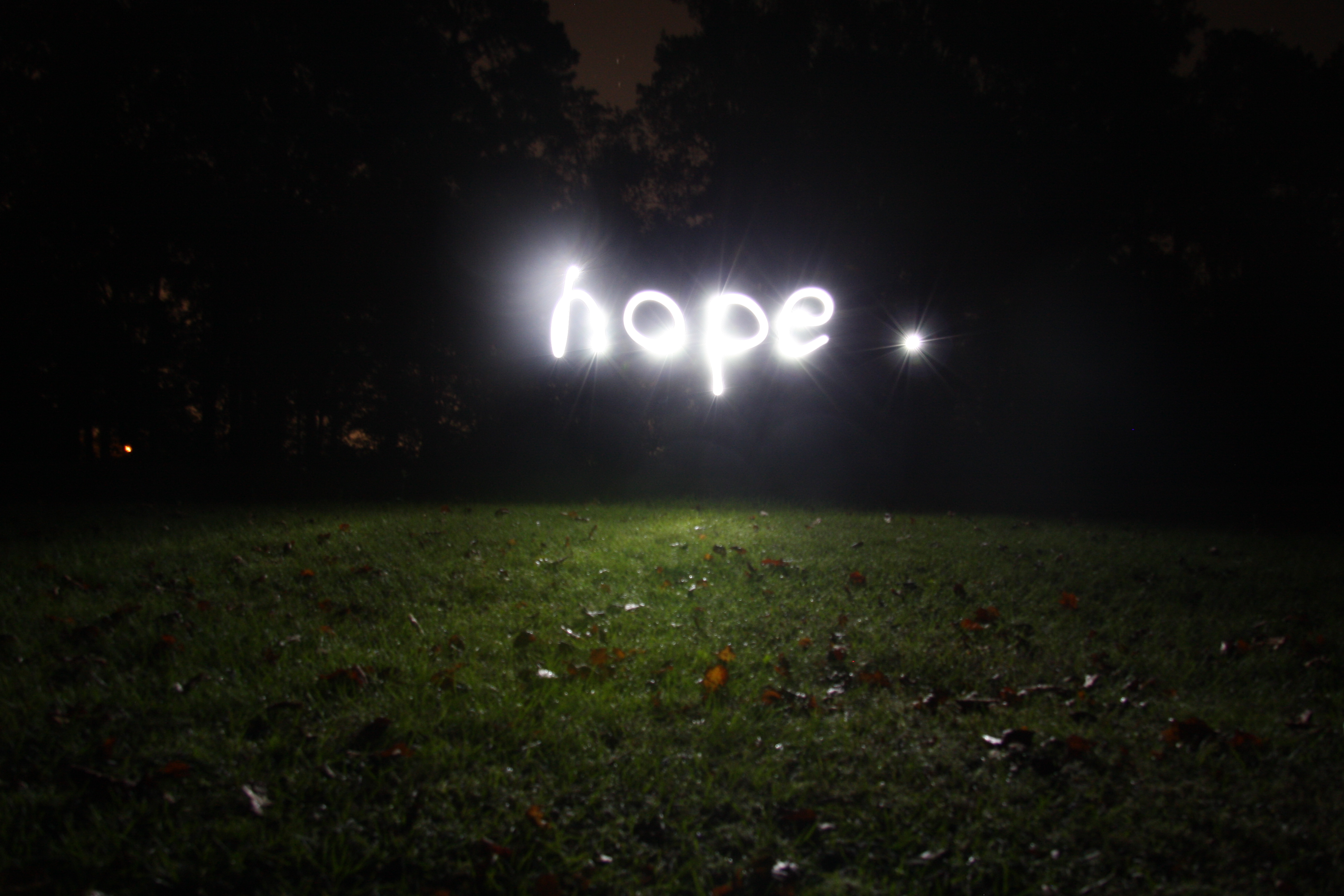
Rumors of Hope

It's not only the events this week in Newtown, Connecticut that should affect us. The world is full of tragedy and suffering. Children die every day of hunger and malnourishment. If you've traveled to the third world or witnessed tragedy you've likely seen the pain on the faces of helpless parents or orphaned children and asked "why?"

Yet in the midst of all of this, we are called to care; called to love; called to serve. We're called to make a difference. That may seem like a daunting task - after all, how can we fix problems on such a grand scale? But, as Mother Teresa said, "If you can't feed a hundred people, then just feed one." I admired her so much for her attitude and her dedication. She also said, "What can you do to promote world peace? Go home and love your family."

We who call ourselves by Christ's name cannot allow ourselves to sink into despair, which is the surrender of hope. Every day we have an opportunity to make a difference in the lives of the people around us. In fact, in Matthew 25, Jesus taught us this lesson in The Parable of the Sheep and the Goats. He said, “When the Son of Man comes in his glory, and all the angels with him, he will sit on his glorious throne. All the nations will be gathered before him, and he will separate the people one from another as a shepherd separates the sheep from the goats. He will put the sheep on his right and the goats on his left.
“Then the King will say to those on his right, ‘Come, you who are blessed by my Father; take your inheritance, the kingdom prepared for you since the creation of the world. For I was hungry and you gave me something to eat, I was thirsty and you gave me something to drink, I was a stranger and you invited me in, I needed clothes and you clothed me, I was sick and you looked after me, I was in prison and you came to visit me.’ “Then the righteous will answer him, ‘Lord, when did we see you hungry and feed you, or thirsty and give you something to drink? When did we see you a stranger and invite you in, or needing clothes and clothe you? When did we see you sick or in prison and go to visit you?’ "The King will reply, ‘Truly I tell you, whatever you did for one of the least of these brothers and sisters of mine, you did for me.’"

There is a light in the darkness; there is a peace in the midst of the storm. As theologian Carl F. Henry wrote about Jesus: "He planted the only durable rumor of hope amid the widespread despair of a hopeless world." Go and do likewise. 
I end with a prayer written by Max Lucado.
Dear Jesus,
It's a good thing you were born at night. This world sure seems dark. I have a good eye for silver linings. But they seem dimmer lately.

These killings, Lord. These children, Lord. Innocence violated. Raw evil demonstrated.

The whole world seems on edge. Trigger-happy. Ticked off. We hear threats of chemical weapons and nuclear bombs. Are we one button-push away from annihilation?

Your world seems a bit darker this Christmas. But you were born in the dark, right? You came at night. The shepherds were nightshift workers. The Wise Men followed a star. Your first cries were heard in the shadows. To see your face, Mary and Joseph needed a candle flame. It was dark. Dark with Herod's jealousy. Dark with Roman oppression. Dark with poverty. Dark with violence.

Herod went on a rampage, killing babies. Joseph took you and your mom into Egypt. You were an immigrant before you were a Nazarene.

Oh, Lord Jesus, you entered the dark world of your day. Won't you enter ours? We are weary of bloodshed. We, like the wise men, are looking for a star. We, like the shepherds, are kneeling at a manger.

This Christmas, we ask you, heal us, help us, be born anew in us.

Hopefully,
Your Children
 
Related Articles: 


Friday, December 14, 2012

Where Is God When You Need Him?


This is a reprint of a post originally written in July, 2012. It seemed appropriate in light of the tragic shooting in Newtown, Connecticut. May God bring peace to all affected by this horrible tragedy.

It's a question I've heard a lot. It comes in different forms but it's basically the same sentiment being expressed: why did this happen to me? If God is so good, then why...? If God can do anything, why didn't He stop my brother, mother, father, son or daughter from dying? Where is God when I needed Him?

It's not a new question. It's been asked from the dawn of time. It was asked by Job - in the oldest book in the Bible. It was asked by King David, a "man after God's own heart." It was asked by Jeremiah, and it's being asked by many today.

The reason that the question is asked is because we're human, and we don't like pain. It's asked of Christians because we believe that what the Bible says is true: that evil is evil; that God is all good; and that God is all-powerful. The argument from some is that one of those statements must be false. Either there's no such thing as evil, as some Eastern religions would teach (evil is an illusion), or God is not all good, or God is not all-powerful. It's called the trilemma.

But when we actually look a little deeper in the Bible we find the answers revealed in the story of mankind. The Bible teaches us that evil is evil, but it doesn't belong here. The world was not created with evil; we were placed in a world without evil, but rebelled and chose our own way. The Bible teaches that God is all good - and He created each of us with freedom of choice. That freedom comes at a cost - sometimes we choose poorly and a price must be paid, often by innocent others. The Bible also teaches that God is all-powerful, but, for a time, allows us to face the consequences of our choices and to, perhaps, change course and find our way home.

So, the Biblical response to the question can be answered with three statements.

  • All is not as it should be. We live in a fallen world - a world at war. The Biblical view begins with a protest: "This is not right!" We see this as Jesus Christ, the Son of God, stood before the tomb of His friend, Lazarus and wept (John 11). Many find this an odd verse, seeing that Jesus was about to raise Lazarus from the dead. But I believe He wasn't weeping for Lazarus. I believe He was weeping for Mary and Martha, the grieving sisters of Lazarus, and for each of us who suffer pain and abuse. He wept because this was not the way that the world was intended to be. When we weep, we echo the sentiments of Jesus at this moment - this is not the way it was meant to be.
  • We are not abandoned. Part of the beauty of Christianity is that it reveals a God of compassion who enters into our suffering and becomes one of us. Jesus is a suffering Savior first. As has been said by others, Christianity has the only God with scars. He has promised to never leave us or forsake us. Like David wrote in his beautiful Psalm 23, "though I walk through the valley of the shadow of death, I will fear no evil, for you are with me." It wasn't just words either. Jesus Christ willingly went to the cross accomplishing redemption for lost humanity. The cross also brought about healing to broken and wounded humanity. It was and is a message of hope in a sometimes dark world.
  • He will make all things right. It sounds trite, but it is true that our perspective is limited, and God sees things much differently than we do. The world is a hard place; sometimes bad things happen to good people, but that doesn't mean that God doesn't care. He has promised that one day all will be made right. Jesus declared, "I make all things new." We long for justice - and justice will be done. We long for what the Jews call "Shalom" - the peace of God. It is the coming of the Kingdom of God into our world. There is a sense in which this Kingdom is to come - some day, heaven. But there is also a sense in which it comes now, in the victories that we can gain right here, right now.       
God calls us to live our lives in light of two very different realities. One is that we live in this fallen, messed up world, and we're to make of it the very best that we can. The second is that we recognize that we are made for eternity, and the way that we live can affect eternity. So to make the most of our lives is to help others become all that they were created to be. St. Francis of Assisi had it right when he wrote these famous words:

Lord, make me an instrument of your peace.
Where there is hatred, let me sow love;
where there is injury, pardon;
where there is doubt, faith;
where there is despair, hope;
where there is darkness, light;
and where there is sadness, joy.

O Divine Master, grant that I may not so much seek

to be consoled as to console;
to be understood as to understand;
to be loved as to love.
For it is in giving that we receive;
it is in pardoning that we are pardoned;
and it is in dying that we are born to eternal life. Amen 
Where is God when you need Him? He's right there with you. No matter what you're going through, He is there. The greater question for most of us is where are we when God calls us to make a difference?

Related Articles: