Showing posts with label Book Review. Show all posts

Saturday, October 17, 2015

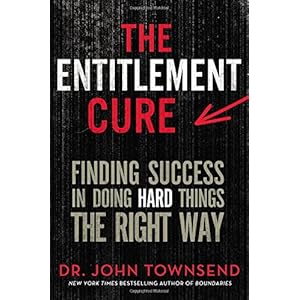
Book Review - "The Entitlement Cure - Finding Success in Doing Hard Things the Right Way"


I was given this book a couple of months ago and asked to write a book review on it. I have taken my time, frankly, because I have been getting so much out of the book that I didn't want to rush the process. 


The Entitlement Cure: Finding Success in Doing Hard Things the Right WayDr. John Townsend, bestselling author of Boundaries, has done a great job of helping us all to understand how to help ourselves and others who battle against the curse of entitlement. We live in an age of entitlement: "the belief that I am exempt from responsibility and I am owed special treatment." We see it everywhere, from employees who don't feel the need to work, to self-centered children, to narcissists to prima donnas in leadership - and in ourselves.

There are some key takeaways this book has provided that have equipped me to tackle some challenges I've been avoiding. Let me lay out a few of them:

1. The Hard Way cures entitlement.

The Hard Way is "the habit of doing what is best, rather than what is comfortable, to achieve a worthwhile outcome." I think we all know this intuitively, but having a definition helps. And the key is in understanding that the Hard Way is also the right way. Short cuts will only keep us from learning lessons we need to master.

2. Entitlement hurts ourselves and others.
We often think that our behaviors and bad habits are our business and ours alone. However, we live in community, our families, our workplaces; even our communities are affected by our choices and the way in which we live our lives. If we choose to engage in self-destructive behavior, it affects everyone who cares about us. If we choose to excuse entitlement in others, we simply pass along the responsibility which someone else must meet. Bad situations don't get better on their own, much as we wish they would.

3. Entitlement is a rejection of reality. 
God created the world with principles within which everything operates. Entitlement is living as if those principles didn't exist. We can wish all that we want to that this world was fair and everyone should have the same opportunity, talent, resources, etc... but wishing does not make it so. We are to do the best we can with what we have - this is success. Townsend outlines 5 life principles which are unavoidable:
  • Humility and Dependence -  We are Completely Dependent on God
  • Connectedness - We are Designed to Live in Connectedness with Each Other
  • Ownership - We have to Take Responsibility for Our Own Choices
  • Accepting the Negative - Your Flaws Can't Be Forgiven and Healed until You Admit Them
  • Finding Our Role - To Live Long and Contentedly, Find Your Purpose in Life and Fulfill It   
4. To change, we must want to change.
If we, as individuals, want to change, we must create the environment where change is possible. Often that means bringing people around us who truly care about us and want to see us grow. In helping others who need to change, often we must first stop doing whatever it is that enables them, and help them to see the consequences of staying the same and the benefits of change. "Relationships which promote growth require the presence of grace and truth in each person."

5. Anything worth doing requires discipline.
Positive change requires an understanding that discipline is a good thing. We need to develop internal structure (the combination of our capacities to focus, persevere, and delay gratification toward a goal) as well as external structure (a framework of reminders and short-term goals that breaks time down into bite-sized elements). As someone said, we first form our habits - then our habits form us.

6. Positive change often starts with saying "I was wrong."
It's certainly not a psychological breakthrough to say that the first step in change is admitting that we need to change, but it's true nonetheless. many things will keep us from this admission, but it is truly necessary to move forward, and is in fact a discipline which needs to be embraced. "Nothing substantive happens in our lives until we humble ourselves enough to say the words 'I was wrong.'"

I highly recommend this book. As I wrote earlier, I will be embracing some needed changes over the next little while, thanks to Dr. Townsend. I trust that you will find it as helpful as I have. This book deserves to be read widely.   

Related Articles:
Book Review: I Am A Follower
Book Review: "The Me I Want To Be"
Book Review: "It Came From Within!"


Wednesday, August 07, 2013

Book Review: The Reason for God - Belief in an Age of Skepticism

Book Review: "The Reason for God - Belief in an Age of Skepticism," Timothy Keller, New York, NY: Riverhead Books, 2008. 310 pages.

Before we begin, here's a little bit of background on Timothy Keller. He is the founder and pastor of the Redeemer Presbyterian Church in Manhattan since 1989. He has grown the church to six thousand regular attendees at five services as of the writing of this book. They have also planted many daughter churches. Timothy has an engaging style, making it a part of his strategy as a pastor to deal with people's objections to the faith. This book is a natural byproduct of that commitment.

The book deals with the major objections to Christianity and belief in God that Keller has been confronted with over the course of his ministry. The introduction begins with his personal spiritual journey. Having been raised in the church, but exposed to the conservative/liberal debate within it, Keller's faith eventually became a casualty of a socially radical liberal university. He speaks of three barriers to faith which were erected in his life: Intellectual - did Christianity make sense? Personal - was God knowable? and Social - Could you believe in God and the Bible and also have a social conscience? Timothy has obviously resolved those conflicts in his mind and entered the ministry to help others do the same.

This book is really about engagement; opening a discussion about faith with those who do not believe. Keller "urge(s) skeptics to wrestle with the unexamined 'blind faith' on which skepticism is based, and to see how hard it is to justify those beliefs to those who do not share them." He also provides first-hand accounts of real people in their spiritual journey. But first he deals with objections to faith which he's encountered.

Objection 1: There Can't Be Just One True Religion
The claim to exclusivity for Christianity is one of the main reasons people gave Keller for rejecting it. This arises partly from the growing liberal value of tolerance - we don't like for anyone to tell anyone that they're wrong - and a negative view of religion in general as divisive and a root of many of the world's problems. Keller deals with this objection by first laying out the options some would propose: we can outlaw religion; condemn religion or keep religion completely private.

Keller explains the presuppositions behind each and then shows why each approach has and will fail. He then launches into an apologetic for Christianity, and a call for the church to follow the model of the early church in bringing its very best into society.

Objection 2: How Could A Good God Allow Suffering?
Here again we find one of the most common objections to belief in the God of the Bible. If God is loving and all-powerful, why doesn't He intervene to prevent suffering? The problem with this objection is that it begs the question: on what basis do we believe that suffering and evil are wrong? As C.S. Lewis concluded, in a purely naturalistic world, we should expect that pain and suffering would be the norm. Yet we have a sense that this ought not to be. Where did that come from? We all must ask, believers and non-believers alike, where does evil come from?

For the Christian, we find the answer in the Biblical record of the Fall of Man and the introduction of sin into the world. According to Keller, "Embracing the Christian doctrines of the incarnation and Cross brings profound consolation in the face of suffering. The doctrine of the resurrection can instill us with a powerful hope. It promises that we will get the life we most longed for, but it will be an infinitely more glorious world than if there had never been the need for bravery, endurance, sacrifice or salvation."

Objection 3: Christianity Is A Straitjacket
The argument here is that since Christianity adheres to a moral code and to a source of absolute truth, the resultant religion must be the enemy of freedom. The questions that must be dealt with here are multifaceted: the nature of truth, community, Christianity and freedom. The underlying assumption here is that "true freedom is freedom to create your own meaning and purpose." It also assumes that all truth is relative, but is it?

Keller answers each of these questions, first by pointing out that, despite our protestations, we all cling to some source of truth, either objective or arbitrary - it's unavoidable. He then demonstrates that within each community there must be an underlying set of agreed upon beliefs and practices which, of necessity, are somewhat restrictive. He also shows that Christianity, far from being culturally rigid, has from the beginning allowed for cultural diversity while maintaining an adherence to orthodox faith. Finally, of freedom itself, Keller tells us that "freedom is not so much the absence of restrictions as finding the right ones, the liberating restrictions." Within Christianity we are free to be the people God created us to be.       

Objection 4: The Church Is Responsible For So Much Injustice
Here Keller identifies three issues: First is the issue of the glaring character flaws of many Christians; second is the issue of war and violence and the church's complicity; third is the issue of fanaticism - what of Christians on the fringe? The first issue is based on a misconception that Christians believe that faith in God makes them better people. It doesn't. One can find Christians at all stages of character development because behavior change is a gradual process, and church should be full of people who are flawed because they are people in process. The second issue is more troublesome, for it is obvious that a great deal of harm has been done in the name of Christ over the centuries. It is wrong and goes against the very teachings of Christ. Finally, fanaticism, tending to express itself in legalism, has pushed many honest seekers out of the church.

It is important to remember that the Bible is also critical of people who act like this. Keller reminds us that "true faith is marked by profound concern for the poor and marginalized." It's not only the church that has been guilty either. In the twentieth century the greatest cause of injustice (human rights abuses, pogroms, death camps, genocide, etc...) were atheistic regimes. This in no way excuses the church when it has been wrong, but it demonstrates that injustice is a human problem, not a Christian one. On the other hand, it has been those motivated by Christian motives who worked to end slavery, campaigned for civil rights and lead the way in social reform, often at great personal cost.

Objection 5: How Can A Loving God Send People To Hell?
With this subject, Timothy shares that many secular minds believe that it is a contradiction to believe in the equality of all people and yet believe in the concept of hell. Keller found several connected beliefs lurking beneath the surface of this one: a God of judgment simply can't exist; a God of judgment can't be a God of love; a loving God would not allow hell. At their root these are preferences. We all would prefer that there would be no hell. The first belief in particular goes against our Western sensibilities and our doctrine of tolerance at all costs. Keller goes to C.S. Lewis to demonstrate that this belief is a cultural adaptation.

As to the second and third charges, relating to the love of God, the implication is that God cannot be both judging and loving. But is that true? The Bible clearly teaches that God is both. Yale theologian Miroslav Volf says it this way, "If God were not angry at injustice and did not make a final end to violence - that God would not be worthy of worship..."

Objection 6: Science Has Disproved Christianity
The famous atheist Richard Dawkins stated that one cannot be an intelligent scientific thinker and still hold religious beliefs. Is he right? In this chapter Keller shows how the supposed war between science and Christianity exists only in the minds of those who hold certain (unscientific) presuppositions. For example, the presupposition that "No supernatural cause for any natural phenomenon is possible" is not a scientific statement, but a philosophical one. He could have done more with this chapter, but this quote is telling: "A majority of scientists consider themselves deeply or moderately religious - and those numbers have increased in recent decades. There is no necessary disjunction between science and devout faith."

Objection 7: You Can't Take The Bible Literally
Keller draws on his own student experiences for this chapter, recalling how many of his college courses caused him to question the reliability of Scripture. It was when he began to do research on his own that he realized how little evidence there was for this revisionist school of thought. The influence of this skeptical view of Scripture has been waning in recent years. Anne Rice, who converted to Christianity after a successful career as a novelist, wrote that "I discovered in this field some of the worst and most biased scholarship I'd ever read." Keller goes on to deal with the typical challenges to the reliability of Scripture, providing solid reasons that the Bible can be trusted historically and culturally.

He quotes C.S. Lewis, who just happened to be a world-class literary critic, as saying: "I have been reading poems, romances, vision literature, legends, and myths all my life. I know what they are like I know none of them are like this. Of this (gospel) text there are only two possible views. Either this is reportage... or else, some unknown (ancient) writer... without known predecessors or successors, suddenly anticipated the whole technique of modern novelistic, realistic narrative..."

In the remaining chapters of the book Keller moves from a defensive posture to providing a positive case for believing, including chapters on:
  • The Clues of God
  • The Knowledge of God
  • The Problem of Sin
  • Religion and the Gospel
  • The (True) Story of the Gospel
  • The Reality of the Resurrection
  • The Dance of God
Even a synopsis of these would take up considerable space but, suffice to say, the book is worth reading, whether you are a skeptic, a seeker or a Christian wanting to deal with some questions. It's not an accident that this book hit the New York Times bestseller list. I'll end with a great quote from Keller: "Jesus's life, death and resurrection was an infinitely costly rescue operation to restore justice to the oppressed and marginalized, physical wholeness to the diseased and dying, community to the isolated and lonely, and spiritual joy and connection to those alienated from God. To be a Christian today is to become part of that same operation, with the expectation of suffering and hardship and the joyful assurance of eventual success."

Related Articles:  
Who Do You Read?
Divine Appointments
Book Review: Mere Apologetics
What is Truth?
"Truth" - by Ravi Zacharias


Friday, November 16, 2012

Book Review: Mere Apologetics

Book Review: "Mere Apologetics: How to Help Seekers and Skeptics Find Faith," Alister E. McGrath, Grand Rapids, MI: Baker, 2012. 197 pages.

Alister McGrath is the president of the Oxford Center for Christian Apologetics in London, England and regularly engages in debate and dialogue with the leaders of the New Atheist movement. I read this book at the suggestion of Ravi Zacharias International Ministries in preparation for this year's Summer Institute. It is written as an introduction to Christian apologetics (taken from the Greek "apologia," meaning defense.) So apologetics is simply a defense of one's position, in this case, the Christian faith.  

McGrath begins by explaining that there are three basic tasks for an apologist: defending, commending, and translating. In defending, the apologist is dealing with barriers that have been erected to faith, whether misunderstandings, misrepresentations or existential issues. In commending, the challenge is to help the audience (whether 1 or 1,000) grasp the relevance of the Christian message. Finally, in translating, the goal is to relate the core ideas of the faith in language and story that makes sense to the hearer.

The second chapter - "Apologetics and Contemporary Culture" looks at the cultural context within which we must function. An approach that may work well in one culture will likely not be as effective in another. So, the challenge is to understand the culture; to be able to determine the common framework through which our audience views the world: ie. modernism and  post-modernism, and to adjust your approach accordingly.

He then deals with the theological basis for apologetics, that there is an important, yet limited role for apologists in helping people find faith. "Apologetics is grounded in a deep appreciation of the intellectual capaciousness and spiritual richness of the Christian faith." It is not about formulas and systems; nor wisdom and reasoning, but simply in helping to break down barriers to faith. It is God, ultimately, who transforms lives.

Next is a section on "The Importance of the Audience." An individual or group's background can differ from another's in many ways, so the method may need to be different as well. We see this modeled in the New Testament as Peter preached to the Jews in Acts 2 using one line of reasoning and reference; and Paul spoke to the Greeks in Acts 17 using another one entirely. They both ended at the same place - Jesus Christ - but they began from different points. We need to ask what our audience believes and why.

Chapter 5 speaks of "The Reasonableness of the Christian Faith." The Christian worldview is truly unlike any other in its capacity to explain things as they are. As C.S. Lewis said, "I believe in Christianity as I believe that the sun has risen, not only because I see it, but because by it I see everything else." There are two ways to demonstrate the reasonableness of the Christian faith. One of them is by showing that there is a good evidential base for the core beliefs of Christianity. The second is by showing that the Christian faith makes more sense of reality than its alternatives.

McGrath then deals with "Pointers to Faith" or approaches to engaging others. "Reality is emblazoned with signs pointing to the greater reality of God. We need to connect the dots and see the overall picture." Some of those signs include: Creation - the origin of the universe; the appearance that the universe is designed for life; the structure of the physical world; the universal longing for justice (morality); the spiritual nature of mankind; our appreciation of beauty, etc...Where do these come from? Apologetics helps to point people to the source.

"Gateways for Apologetics" follows logically from the previous chapter - it's all about opening the door to faith. Many people have never considered the claims of Christianity, may even be antagonistic, and would be more likely to respond to one approach over another. So, what are the gateways? The first is explanation, which requires an ability to share the basics of the faith. The second is argument - building a rational case leading to faith. Examples include the argument from design or the argument from morality. The third gateway is stories. This approach is particularly useful in dealing with postmoderns, who have a tendency to reject an appeal to reason. The final approach mentioned is images, which builds upon the previous model. Postmoderns tend to prefer pictures, not words, in their communication. C.S. Lewis was a master at these last two gateways.

The last chapter before the conclusion is "Questions about Faith." This deals with helping people at the point of their own stumbling. Some have had bad experiences with Christians; others may be from a Muslim background and stumble at the church's history of the crusades. Many stumble at the question of evil. What are the keys to dealing with someone with real questions? Be gracious. Look beyond what is said to the real question. Don't just give prepackaged answers; be genuine. Learn from other apologists.

This book provides help for those trying to develop their own skills as an apologist. It is not so much a list of arguments to use, but rather it is a guide to help to develop and refine one's approach. I'll end with some good common-sense advice from McGrath: "Before we can answer the questions others ask about our faith, we need to have answered them for ourselves."

Related Articles:
Book Review: "Why I Still Believe"
Book Review: "Has Christianity Failed You?"
"Truth" - by Ravi Zacharias
Book Review: "Why Jesus?"
Are Christianity & Science Incompatible?


Tuesday, July 03, 2012

Book Review: The Last Christian On Earth

Book review: "The Last Christian on Earth - Uncover the Enemy's Plot to Undermine the Church," Ventura, CA: Gospel Light, 2010. 254 pages.

Os Guinness earned a DPhil from Oxford University , has been a freelance reporter for BBC, and visiting fellow at the Brookings Institution  and a guest scholar at the Woodrow Wilson Center for International Studies.

I had the opportunity to hear Os Guinness teach a short time ago at the RZIM Summer Institute. I was impressed by his ability to communicate and his obvious understanding of history and contemporary culture. His grasp on the forces shaping our culture is obvious after reading "The Last Christian on Earth."

This book was originally published in 1983 under the title "The Gravedigger File: Papers on the Subversion of the Modern Church." It has been updated and re-released. The gravedigger thesis, the theme around which the story is written is this: "The Christian faith contributed decisively to the rise of the modern world, but it has been undermined decisively by the modern world it helped to create. The Christian faith has become its own gravedigger."

Os Guinness
Born in China, educated in Europe and living and working in the U.S. has given Os Guinness a unique perspective from which to analyze the church. In the style of John le Carré, and reminiscent of Lewis' "The Screwtape Letters," Guinness has used the literary device of writing memoranda from one spy to another about how to undermine the church. It is a thought-provoking work that should be read by Christian leaders and influencers.

It certainly gives much food for thought on where the church has gone wrong and how to correct those errors. It speaks of the different reactions to modern culture and where they have failed: from the trap of isolationism to the compromise of liberalism and points in between. The question he asks is pertinent for every Christian leader: "Can we regain the full integrity of faith in Christ while fully and properly engaged in the advanced modern world?"

The answer is, obviously, "yes," but the questions remain. "How will we?" and "will we?" Guinness recommends that "the old three-step approach of 'discern, assess, and engage' is still the better way." So this book is an invitation to take a serious look at the culture in light of the Gospel - and this can only begin with a renewed commitment to the core truths of the Gospel. Thus, Guinness ends the book with a printing of "An Evangelical Manifesto," written in 2008 by a number of Evangelical scholars including Charles Colson. It is a call to do exactly what Guinness' book calls us to do. I recommend this book for any serious Christian concerned about how best to engage the culture.     

Related Article:
What Do You Believe And Why Does It Matter?
What's Wrong With the Church?
Book Review: "The Me I Want To Be"
Book Review: "The Harbinger"
Book Review: "Why Jesus?"


Thursday, March 29, 2012

Book Review: "Why Jesus?"

Book Review: Ravi Zacharias, "Why Jesus? Rediscovering His Truth In An Age Of Mass Marketed Spirituality" New York, NY: FaithWords, 2012. 281 pages.

Reading one of Ravi Zacharias' books reminds me of going out to dine at a nice restaurant after only eating at fast food joints. It's a little bit more work, but a lot more rewarding. I remember when I first started reading Ravi. I would have to have a dictionary close by because his vocabulary was and is a lot larger than mine. The extra effort is worth it. His writing has had more influence on my life and ministry than almost anyone else.

"Why Jesus" was written in response to the new spirituality espoused by such luminaries as Oprah Winfrey and Deepak Chopra. As Ravi states in his introduction, "it is hard to imagine a culture more gullible than that of America today, priding itself on being a culture that is willing to absorb anything indiscriminately." (p. xiv) The combination of the power of the media, spiritual hunger and erroneous teaching mixed with bits and pieces of the truth is a volatile combination.

This book sorts through the roots of these new movements, identifying why they cannot ultimately satisfy, finally ending with a case for why spiritual satisfaction can only be found in the person of Jesus Christ. The journey is a long one, but Ravi's perspective is particularly helpful. He was born in India, with a deep understanding of the culture of his birth and also of the Eastern roots of the new spirituality (which is not new at all).

Chapter 1, called Movie Making or Soul Making, delves into the power of the media to shape worldview. He states "The world of entertainment has become the most powerful means of propaganda, and the audience is unaware of how much it is being acted upon and manipulated, paying for it not only in cash but in having its dreams stolen." (p. 6) Ravi is not claiming a conspiracy theory, rather that many of the creative among us have been seduced by Eastern thought, which has also paraded itself in scientific terminology. The following quote summarizes the chapter well:
"We have found a religion that has helped us to revolve around ourselves, and once we have believed that the spiritual imagination needs no boundaries because we are gods, everything becomes plausible and nothing needs justification. We are now in the precarious situation where science has given us the tools - and possible the imperative - to convey fiction, and fiction has the pervasive power of science. This is the New Spirituality." (p.10)
Chapter 2 - How The West Was Lost Through Its Gains continues with a history of how the views of North Americans have been shaped by television and now the internet. Far from being benign, "the visual media, especially television and movies, manipulates us into seeing with the eye, devoid of the conscience, whose role it is to place parameters around what we see."
"The end result is spirituality without dogma, religion without God, argument without substance, rationalization without rationality, and tranquillity by transfer of funds from the seeker's bank account to the company that makes the best offer of nirvana, at the same time producing dogmatism about relativism in matters of ultimate meaning."
Part of the reason for the decline of the influence of Christianity in North America was the abuse of the media and the audience by Christian televangelists, who have been used as caricatures. The spiritual hunger continued, but the young rejected the faith of their fathers and opted instead, for an "egalitarian, all-inclusive, nonjudgmental, non-Western way of looking at things." (p. 38)

Ravi suggests three layers that make up the "rebellion against the status quo of Western society... first, the disillusionment with materialism and the status quo; second, the shallowness and, at times, hypocrisy of the Church, or of those who claimed to be Christians; and third, and perhaps most compelling, a desire for liberation from all restraint, especially in matters of sexuality."

Chapter 3 - Exhaling The Old, Inhaling The New deals with the philosophical shifts in society from rationalism to empiricism, then to existentialism, finally arriving at postmodernism. These shifts have had a great impact in all aspects of society, certainly in how we engage and answer the most important questions. As Ravi states: "We are at a time when postmodernism defies certainty, truth, and meaning; when spiritualism dabbles in quantum theory; and when randomness has become the order of the day." (p. 58)

Chapter 4 - From Oprah to Chopra deals with the rise from obscurity to the pinnacle of the New Spiritual movement of both Oprah Winfrey and Deepak Chopra. Ravi here goes into detail on the journey of Oprah and her changing spiritual views. "Once you have gained a following of such magnitude; once you can do no wrong by virtue of the adulation you receive; once you are one of the richest people in the world and can buy the companies that sponsor you; once you have a magical impact on the minds of people... is it not a short step to playing god in the minds of your followers?" (pp. 74-75) Oprah uses her considerable platform to push The New Spirituality espoused by people like Eckhart Tolle. Deepak Chopra, in a similar vein, pushes his blend of spirituality with quantum physics. What do they have in common? Wealth and spiritual talk.

Chapter 5 - The Religion of Quantum focuses on Chopra and his "new spirituality combined with his brand of gimmickry." He speaks of Chopra's claims that "'quantum healing' can defeat the aging process, that the mind may be healed by harmonizing or balancing the 'quantum mechanical body.'" 
Ravi points out that Deepak's claims misrepresent both science and Hinduism and are a disservice to both - but they have made Chopra rich and popular.

Chapter 6 - Go West, Young Man speaks of the trend in American culture to embrace unquestioningly all that is Eastern. Ravi here brings his extensive knowledge of Eastern thought and Christian theology to shine a light on the hypocrisy of many in the New Spirituality movement, who promote positive aspects of Eastern religions while completely ignoring the flaws. At the same time, Christianity is attacked for the abuses of some while its role in shaping Western Civilization is ignored. "In Europe, Christianity was abused when it was used for political power; in America it has been abused by using it for economic power. And today it is abused by its detractors who deny its power and remove it from any position of moral authority." (p. 102).

Chapter 7 - The Three Gurus is a chapter dealing with the three gurus whose influence has shaped much of Eastern mysticism today. These are Swami Vivekananda, Yogananda and the Maharishi Mahesh Yogi (founder of the Transcendental Meditation movement). Ravi quotes Richard Neibuhr as he summarizes the affect of their teachings: "'in all these religious theories and expressions, what we are really looking for seems to be 'a God without wrath who took man without sin into a kingdom without righteousness through the ministrations of a Christ without a cross.'" (pp. 129-130).

Chapter 8 - Smiling Your Way Through Puzzles deals with the manner in which Eastern religions deal with questions of truth. This chapter is helpful for anyone wanting to understand the differences between Buddhism, Hinduism, Taoism, Confucianism and other branches of Eastern philosophy. Portions of all of these - and of Christianity - are blended together to form the New Spirituality. "If you shine your light on one chapter of the New Spirituality, it can almost look like Christianity. But when you shine the light on another chapter, you're sure it's Buddhism, then Hinduism, then Taoism. This is brilliance at work in a culture of spiritual hungers and an aversion for dogma... But still hanging over our heads is the fact that relativism must eventually pay its dues in the currency of reality." (pp. 148 - 149).


Chapter 9 - Do You Really Want To Live? speaks to the question of meaning. What is life all about? How does the Christian worldview make sense of the problem of pain and the pursuit of pleasure? These are questions which other belief systems struggle to answer and for which the Bible provides unique responses.

Chapter 10 - The Ties That Bind carries on with the theme from the last chapter, speaking of pleasure and pain in the context of relationship, stewardship and worship which is uniquely offered in Christianity. "There is a clear and unequivocal assertion in the Judeo-Christian faith that God created us for his purpose: to fulfil life's sacred nature within the particularity of an individual life, in relationship with him and his indwelling presence."

Chapter 11 - The Search For Jesus deals with the loss of Biblical literacy in North America and the resulting ignorance of the historical Jesus. This has brought to pass what Ravi speaks of: "The Jesus of the New Spirituality is a Jesus of myth, not fact... New Age Spirituality keeps losing Jesus because it reduces him to just another voice and just another teacher or master." Further, Ravi states his case: "This is the strongest indictment I make against the New Spirituality. They have violated the true Jesus and formed him in their own image. While exalting themselves, they have denigrated him. Against the backdrop and the evolving ethics of a culture that is lost, the New Spirituality has manipulated the text of Scripture, ignored history with redefinitions of their own to leverage cultural desires to their own advantage."

Chapter 12 - Reshaping Jesus To Suit Our Prejudices reveals firstly the damage that has been done by New Age Spiritualists who have either deliberately or ignorantly misinterpreted the Bible to promote their distorted Jesus. "In their deep prejudice against Christianity, advocates of the New Spirituality malign the Christ of history in order to remake him into an image that is consistent with their ideas." (p. 210) Secondly, Ravi speaks of how some churches have contributed to the problem by neglecting the Biblical message of Christ and ignoring the spiritual disciplines. Pages 216-218 provide a succinct critique of the New Spirituality movement.

Chapter 13 - The Greatest of All continues to build the case as to why Jesus is the only answer for those seeking fulfilment. "True spirituality is not a game we play. It is not merely a preference for some position over another. Nor is it at its core a search for some healing balm. It is an ultimate choice of ultimate definitions that require one's utmost commitment."

Chapter 14 - False Assumptions and Magnificent Truths wraps up the book by looking at "The Three All-Important Questions" all worldviews and religions must be examined by. They are:
  1. How do they answer the question of exclusivity as it relates to their own belief?
  2. What is the source of their authority?
  3. How relevant is what they believe to the common experience; what difference does it really make?
Also in this chapter Ravi includes a section on Building A Worldview, which gives the basic components that must be addressed. "Jesus proclaims the truth - that is why it must exclude all that is contrary to it. He lived and spoke with authority - that is why what he said applies to each of us. His message bridges the greatest gulf within us - that is why it is relevant even today, two thousand years later." (p. 269)

This book is not an easy read, but none of Ravi's books are. It is not fluff, but is designed to engage the mind to wrestle with serious issues. It's worth the effort.

Related Articles:
Some Books Worth Reading
"Truth" - by Ravi Zacharias
Ravi Zacharias and Dr. John Lennox take on Stephen Hawking
Ravi Zacharias and Dr. John Lennox take on Stephen Hawking cont.
Book Review: "Has Christianity Failed You?"

Wednesday, January 04, 2012

Book Review: "The Book of Man - Readings on the Path to Manhood"


A number of years ago I attended an auction where I successfully bid for a box of old books. When I got home I found among them a book called "The Sunday Reader at Home" from 1896. The book was a collection of short stories, poems and tales all designed to teach life lessons. As I began reading "The Book of Man" I immediately was drawn to the similarity.

William Bennett served as the Secretary of Education in the U.S. under Ronald Reagan and is a New York Times best-selling author. What I most like about Bennett is that he writes with a purpose. While I got this book from the publisher for free in return for a book review, I would have purchased it nonetheless. It is written in response to the crisis of manhood in our culture. As he quotes David Brooks as saying in his introduction: "One-fifth of all men in their prime working ages are not getting up and going to work."

Probably more telling are his own words: "There was once a common understanding in our society among men that there are standards of action and behavior to which men should hold themselves. Men, the code dictates, among other things, keep their word, whether in writing or not, men do not take advantage of women, men support their children, and men watch their language, especially around women and children. The code of men is fading."

This book is written to provide a tool with which to instill these positive values into the lives of their own children. I wish I had found this when my children were younger - it would have made my life so much easier. Many will find parts of this book challenging due to its content (some stories are ancient tales), but it's good to be stretched. The short readings are broken down into six different areas of life, and are aimed at calling out the very best in the masculine soul.

Part 1 is called Man in War. This is not to promote war or violence as an answer, but to recognize that there are times when a man needs to take a stand and risk his own welfare for the sake of those he loves. This includes the famous St. Crispin's Day Speech by Shakespeare, a poem by Wordsworth, a piece by Winston Churchill and profiles from modern-day men of honour.

Part 2 is titled Man at Work. It is designed to teach once again the value of hard work, which in large part has been lost in our culture. As Bennett quotes Roosevelt as saying, "Far and away the best prize that life has to offer is the chance to work hard at work worth doing." This section opens with the story of a "proud sanitation worker" and ends with "Pensees" by Blaise Pascal. In between you'll find a tremendous variety of great readings.

Part 3 is called Man in Play, Sports, and Leisure. It is a call for men to recreate responsibly, moving away from the modern toys which tend to turn off both body and mind. It speaks of the pursuit of excellence in all that we do, beginning with the story of "Pistol" Pete Maravich, one of the NBA's all-time greats. There are sections from Tolstoy, Lincoln, and Francis Bacon as well as pieces by and about many more current personalities.

Part 4 is Man in the Polis. This refers to the need for men to take their part in the body politic, whether that means government service or simply being a responsible member of society. As Edmund Burke wrote, "All that is necessary for the triumph of evil is for good men to do nothing." This chapter is aimed at preventing that eventuality. It includes interesting pieces like a speech given by David (Davey) Crockett before the U.S. House of Representatives. It also features pieces by luminaries like Kennedy, Chesterton, Reagan and Washington. Well worth the read.

Part 5 is about Man with Women and Children. The lessons in this section are sorely needed today as "men are missing from the lives of women and children today in increasing numbers." Men need to learn values of respect, devotion, loyalty and compassion, all of which are seen in these stories. The articles, whether by Yeats, Dickens or Thomas Jefferson, all seek to call out the best of man in support of their family. Add to this the modern profiles and we see how this can still be lived out today.

Part 6 concludes the book with Man in Prayer and Reflection. Bennett states that "the true root of a man's existence is his ability to think and reflect." Part of the problem in our modern culture is that many seem to have lost the capacity or the will to do this. The result is many men who are governed by appetite rather than reason. This section includes glimpses into the spiritual lives of many of the greatest men in world history, including many of the U.S. Presidents and church leaders like Billy Graham and Charles Spurgeon.

This book is not one that you just sit down and read. It is designed to be read, one story at a time, when there is time for reflection and conversation between father and son. As I said earlier, I wish this was available when my children were younger. I highly recommend this for all of you fathers out there.

Related Articles:
Defending Marriage
Why I Believe In Marriage
Video - Regrets of a Father
Book Review: "The Grace of God"

Monday, October 03, 2011

Book Review: "The Grace of God"


Andy Stanley has done it again. I just finished reading his newest book, "The Grace of God," and came away amazed all over again. In his easy-to-read style, this great communicator walks through the Bible, demonstrating that the grace of God is the theme of Scripture, from Genesis to Revelation.

This is a message that we all need to hear, particularly the church. As Andy states in his introduction, "The gravitational pull is always toward graceless religion." For this reason, church has become a place that is designed by church people for church people. Yet the heart of God has always been drawn to those outside of the circle: the lost, the hurting, the disenfranchised.

Stanley begins by breaking down the myth that the God of the Old Testament is fundamentally different from the God of the New Testament. He does this by showing that "God's law is never given to establish a relationship; God's law is given to confirm an existing relationship." The law exposes our sin and reveals to us our need for a Saviour, our fundamental need for grace.

Interestingly, Andy delves into numerous Old Testament stories which are not often given much thought, mining them for evidence of grace. Chapter 3, "Surprised By Grace" is a good example, as Andy looks at the Joseph story through the eyes of Judah, Joseph's brother. God's grace is clearly seen in Judah's life as he is blessed beyond anything he deserves. "Grace is not reserved for good people; grace underscores the goodness of God."


What I appreciated more than anything else were the last few chapters dealing with the church. I, too, have seen the need for church that is grace-filled, designed for people who are not churched. Our communities are full of churches that cater to the needs of people who look, dress and act the part. Yet Jesus modelled for us a lifestyle that engaged and fellowshipped with hurting people, one that was not about rules, but relationship.

The most profound lesson is a simple one, coming from the Jerusalem Council in Acts 15:19 - "...we should not make it difficult for the Gentiles who are turning to God." We are not drawn to relationship with God by rules, but by grace, God's unmerited, undeserved love for us. The main takeaway for me is this: don't allow my preconceptions or biases to ever cause me to forget the truth that we are saved by grace alone.

Related Articles:
Book Review: "It Came From Within!"
Book Review: "What Good Is God?"
Book Review: "Has Christianity Failed You?"

Saturday, September 03, 2011

Book Review: The Leadership Secrets of Billy Graham


Book Review: Harold Myra & Marshall Shelley, "The Leadership Secrets of Billy Graham" Grand Rapids, MI: Zondervan, 2005. 348 pages.

This book was written as part of the fiftieth anniversary celebrations of Christianity Today International, an organization which began largely due to the inspiration and vision of Billy Graham. It set about to explore what made Billy Graham so successful as a leader for such a long time. He has been on the international stage since the 1940's and is one of the most influential people of the twentieth century. I read the book to see what I could glean from a man who has stood the test of time and still holds the respect of world leaders and the common man.

The book is split up into six parts:
Part 1 - Coming Alive
Part 2 - Getting Started
Part 3 - Creating Momentum
Part 4 - Growing Through Fire and Ice
Part 5 - Multiplying Momentum
Part 6 - Deepening In Every Decade

Rather than explore each of the 21 chapters, which would take up too much space, I'll deal with each of the six parts. Each part, I believe, represents a stage which each leader will go through if they are to have lasting success.

Part 1 - Coming Alive. This is the shortest section, consisting of only one chapter, called "Igniting." It is appropriately titled, describing the "call to ministry" and early defining moments of an ordinary young man from Charlotte, North Carolina. What is noteworthy is not simply Billy's willingness to go wherever he felt that God would lead him, but his continued humility and openness to continually allow God to change him as necessary. His early years marked a growing willingness to confront his own prejudices and to stand firm in the face of the criticism of those who felt that he was compromising. He firmly believed that, in moving forward in obedience he would naturally have to face hardship. Sherwood Wirt, longtime editor of "Decision" magazine, wrote that "All attempts to explain Billy Graham fail unless they begin at the cross."


Part 2 - Getting Started. This section deals with four factors which were key in Billy Graham establishing the trajectory for a lifetime of successful ministry. They are: Forming The Team, Confronting Temptation, Lasering In on the Mission, and Loving Harsh Critics. At the end of each cchapter is a section on application.

As John Maxwell writes, "To collaborative team members, completing one another is more important than competing with one another." Billy carefully selected those who would work closest to him; he pursued them, asked for a commitment, and most of them stayed with him throughout his active ministry - an incredible accomplishment seeing it lasted 60+ years. While many see Billy Graham, few see the committed group that he placed around himself who, while capable in their own right, allowed him to shine. He also had to develop the character to keep his heart pure and his reputation intact. This was vital for a ministry which lasted more than half a century. Not only that, but he had to learn to say "no" to the many "good things" that could have distracted him from his purpose, including offers from Hollywood and Washington. Finally, he had to learn how to handle the inevitable criticism. His humility allowed him to learn from even the harshest critics and, often, to turn enemies into friends.

Favorite quote: "Be thoroughly acquainted with your temptations and the things that may corrupt you, especially those temptations that either your company or your business will lay before you." - Richard Baxter

Part 3 - Creating Momentum. This section deals with four keys to creating momentum. They are: Communicating Optimism and Hope, Mobilizing Money, Empowering Soul Mates and Expanding the Growing Edge.

As Napoloen said, "Leaders are dealers in hope." When looking from a distance at larger-than-life leaders like Billy Graham, we tend to believe that everything came easily. This, of course, is not the case. Every ministry, business or career has struggles. A positive attitude is essential to lead a team to overcome. Realizing that almost every time that Billy preached a crusade he used stadiums whose rent costs were in the millions of dollars, he had to learn to be proactive in fundraising. He was successful, partly because of the high degree of accountability. Billy Graham helped to establish an organization (The Evangelical Council for Financial Accountability) to help Christian ministries like his to maintain the highest financial standards. As the ministry grew larger in its scope, Billy had to learn to release more and more responsibility into the capable hands of the team he assembled. He was a master at helping others find their place and reach their potential. Billy was also not one to run from the challenge of a changing world. He was one of the first to integrate his rallies in the South, at risk to his reputation. He also took the lead in adapting new methodologies to communicate Biblical truth, staying relevant to new generations of people worldwide.

Favorite quote: "In periods where there is no leadership, society stands still. Progress occurs when courageous, skillful leaders seize the opportunity to change things for the better." - Harry S. Truman

Part 4 - Growing Through Fire and Ice. This section is broken into four parts that deal with how Billy Graham responded to the troubles and challenges he faced in his ministry. They are: Summoning Courage, Learning from Failure, Experiencing Trauma and Betrayal and Redeeming the Ego.

What do you do when faced with an unpopular choice? Billy Graham had to learn to brave attacks from the press, government officials and sometimes even disagreement among his own team. He had to learn how to have the courage of his convictions. He also had to learn from his failures of judgment, from which Billy suffered early in his career. One of the most difficult things to endure is the betrayal of a friend; Billy felt the pain when Richard Nixon resigned the Presidency and Billy discovered that he had been deceived. In spite of the public embarassment, he was able to forgive and continue to minister to the family. One of the main reasons I believe that Billy Graham was successful was that his confidence was based in Christ, so his ego was held in check. He knew that it wasn't about him.

Favorite quote: "Mishaps are like knives that either serve us or cut us, as we grasp them by the blade or the handle." - Herman Melville

Part 5 - Multiplying Momentum. This describes four ways in which Billy Graham was able to successfully expand his ministry throughout its sixty years. They are: Birthing Dreams, Building Bridges, Igniting Other Leaders, and Sowing Seeds in All Seasons.

When Billy heard about worthwhile visions, he leant his considerable influence to help get them off the ground. These include World Vision, Christianity Today, and the International Congress on World Evangelization. According to Dr. Robert Evans, founder of Greater Europe Mission, Graham was responsible, either directly or indirectly for the start-up of twenty-five evangelical organizations in Europe alone. In a time when the church was extremely divided, Billy Graham built bridges between liberals and conservatives, Catholics and Protestants and across racial, cultural and social barriers. One of a leaders greatest gifts is to pass the baton, Billy has done that with many younger leaders, mentoring, encouraging and supporting. People like Jay Kesler, formerly of Youth For Christ, Rick Warren of Saddleback Community Church, Ravi Zacharias, a noted apologist, and countless other leaders around the world have been profoundly influenced by him. Throughout his ministry Billy Graham has taken the time to plant seeds which may never see fruition in his lifetime.

Favorite quote: "Life is not just a few years to spend in self-indulgence and career advancement. It is a privilege, a responsibility, a stewardship to be lived according to a much higher calling." - Elizabeth Dole

Part 6 - Deepening In Every Decade. This last section has four chapters on how Billy was able to last. They are: Learning - and Leveraging Weaknesses, Plugging into Continuous Voltage, Innovating, and Leading with Love.

Billy Graham is remarkable in his humility. Admitting he is not a great preacher, he leveraged that by inviting input from people all over the world who could help him have insight into the different cultures to help him stay relevant. This trait also helped him to get the best out of his team. Billy also recognized that without God he was nothing. Each day he spends hours in prayer and in reading the Bible. It keeps his heart soft and his ears open to hear God. Perhaps because of this, Billy was always open to integrating new techniques and technologies into his ministry.

The final chapter - Leading With Love - deals with what close observers believe is the key to the success of Billy Graham. He loves people, pure and simple. He takes time for people, regardless of who they are. His concern is genuine. He reached out to Jim Bakker after his much-publicized moral failure. He reached out in love to Muslims after 9-11. He took the time to get to know the family members of his staff and gave sacrifically to help others. He lead by example.

Favorite quote: "I have learned that although Christians do not always agree, they can disagree agreeably, and that what is most needed in the church today is for us to show an unbelieving world that we love one another." - Billy Graham

Conclusion: All in all it's a good read. It's not so much a leadership tome as it is a tribute to Dr. Graham. It does provide tremendous insight into the leadership longevity of one of the most influential people of the twentieth century.

Related Articles:
Book Review: "What Good Is God?"
Book Review: "Why I Still Believe"
Book Review: "It Came From Within!"
Book Review: "Has Christianity Failed You?"
Book Review: "The Power Of A Whisper"
Book Review - "Heaven Is For Real"


Thursday, March 03, 2011

Book Review: "Why I Still Believe"


Book Review: Joe Boot, "Why I Still Believe: (Hint: It's The Only Way The World Makes Sense)" Grand Rapids: Baker Books, 2006. 159 pages.

Joe Boot, the author of "Why I Still Believe" wass the Canadian Director of RZIM Ministries (Ravi Zacharias). He is the founding president of the Ezra Institute for Contemporary Christianity in Toronto where he currently serves as senior pastor of Westminster Chapel. As such, he is well-versed in apologetics, speaking around the world in universities, churches, colleges and conferences.

This book is a little different from the normal works of apologists(defenders of the faith) as it deals not so much with rational proof for Christianity, as with building a case that Christianity is the most reasonable worldview. His rationale, with which I happen to agree, is that the presuppositions of Christians and non-Christians are so far apart that there is little common ground on which to build an objective argument.

So Boot takes the time to compare the worldviews, making the case that the Christian worldview, alone, provides satisfying answers to life's ultimate questions. As C.S. Lewis said, “I believe in Christianity as I believe that the sun has risen: not only because I see it, but because by it I see everything else.”

He begins his book by showing that much of what we believe, Christian or not, is based upon pre-suppositions. For example, he notes that even scientific journals admit that the big bang theory of cosmology is based upon a number of hypothetical entities - things that we have never observed. They are unproven pre-suppositions, without which the theories would fall apart. As an article in the New Scientist Journal stated: "In cosmology today, doubt and dissent are not tolerated and young scientists learn to stay silent if they have something negative to say about the standard big bang model."

These pre-suppositions exist in most, if not all, areas of science and of religion. The premise of evolutionary theory, for example, is that there must be a naturalistic explanation for all life forms. All evidence is therefore understood through that filter, the questions arising from the Cambrian explosion notwithstanding... So, in all disciplines and walks of life a certain amount of faith is required, but I digress.

Joe speaks about his upbringing and the different views to which he was exposed as a child and a youth. There was a steady bombardment of ideas that ran contrary to the Christian beliefs of his parents. He found himself, from an early age, wrestling with the competing worldviews he encountered. He realised, as I have, that of all of the worldviews out there, Christianity is the one which seems to be a lightning-rod for criticism. Some of that criticism is due to the hypocrisy of some Christians and Christian organizations. But some is also due to the very direct truth claims which fly in the face of our modern views of "tolerance." When Jesus claimed to be "the way, and the truth, and the life" He drew a line in the sand, stating by implication that all contrary views are false.

I love his chapter Ridicule and Rebuttals, in which he speaks of the attitude of Christianity's critics. I'll let him speak for himself in a lengthy, but well-written paragraph. (I love the sarcastic tone). "Have I never heard of Charles Darwin and macroevolution? Do I not realize that the Bible has been disproved - Richard Dawkins says so! Have I been living on Mars for the last thirty years? Have I not encountered the work of David Hume, Immanuel Kant, Friedrich Nietsche, Karl Marx, Aldous Huxley, Anthony Flew, or Bertrand Russell? Am I unaware of French existentialism? What about Camus, Sartre and Derrida? Do I not realize that such people, and many other thinkers, have shown the inadequacy of arguments for God, the miraculous, and biblical history? Have I not read that 'God is dead,' that religion is just the opium of the people? Have I not understood that all religious language is meaningless or that Christianity is not empirically verifiable? Surely I am conscious of the loneliness of humankind in the universe, that all is meaningless, and life is only what I define it to be or make of it? Humankind has come of age; we are autonomous, free, self-determining. And surely I understand that history itself and all religious claims are mere power plays to control and manipulate others. All is relative; there can be no objectivity in history: that's objectively certain! There are no absolutes, and that's absolutely final! It's all a matter of personal interpretation. What's true for you isn't necessarily true for me. Joe Boot, you really have been living in a box; you are so behind the times! Your parents merely passed on to you their human projection of a 'father figure' due to their insecurity and poor relationship with their parents; what you now depend on as 'god' is a psychological disorder - Freud taught us that. No, I'm afraid this biblical concoction of God will not be tolerated in our tolerant society. It's back to school for you, Joe Boot."

I love this paragraph because I've heard so many of the lines myself from people who cannot believe that I, an educated person, could actually believe this Christianity stuff. I see a great deal of my own journey in Boot's story. I left the faith of my childhood in search of truth only to arrive back home after other worldviews had left me empty and needing more. The more I learn of God, His Word and His world the more I am convinced that Christianity is true. His use of a quote by Cornelius Van Til at the beginning of a chapter called No Apology is appropriate here: "Faith is not blind faith... Christianity can be shown to be, not 'just as good as' or even 'better than' the non-Christian position, but the only position that does not make nonsense of human experience."

Boot then gives some helpful tools to actually assess the validity of worldviews, much of it I believe from Ravi Zacharias. I have some of this information in an older blog if you're interested. The point is that Christianity is not only true - it works in real life, which is where all worldviews should be measured.

I encourage you to read this book, particularly if you're on a search for truth. If you're one of those that I hear from on occasion who have rejected Christianity for whatever reason, I really would like your feedback on this one. If you are a Christian, I believe that this will help to bring some things into perspective for you.

Friday, February 18, 2011

Book Review: "It Came From Within!"


Andy Stanley has been called "one of our generation's great communicators." I would tend to agree, and this book is a very well written book that should have a long shelf-life because of its practical application. "It Came From Within! The Shocking Truth Of What Lurks In The Heart" is eye-opening for anyone interested in dealing with baggage from their past.

Andy uses the theme of cheesy monster pics to demonstrate spiritual truth - thus the 'B' movie monster on the front cover. He begins by giving real life examples of how each of us do our best to hide those monsters that lurk inside of our hearts: guilt, anger, greed and jealousy. Some of us deny that we are susceptible to any of them, but we could all see ourselves in his examples. We blow up at a loved one for a seemingly small infraction; we fall into a destructive habit; we dwell on things that we know will drag us down or perhaps we simply refuse to forgive someone.

The first few chapters are spent building a convincing case that we each need to find a remedy. You may start reading as a doubter, but I think after a few chapters, you'll find an application for your own life. The reason for the book is simple - the heart matters. Jesus spoke to this when He said clearly "For out of the heart come evil thoughts, murder, adultery, sexual immorality, theft false testimony, slander." (Matthew 15:19)

Andy insightfully explains that each of these four "enemies of the heart" results in a debt-to-debtor dynamic that messes up our relationships. As long as we feel that someone owes us, our relationship will never be quite right. There are only two ways to resolve this: either the debt has to be paid or it has to be forgiven.

The dynamic of guilt, for example, takes the form of "I owe you." We've done something we perceive as wrong and some spend the rest of their lives trying to make up for it. Anger, on the other hand, says "You owe me!" It's the result of not getting what we want. Think about the last time that you were angry. Wouldn't it have been resolved if things had simply gone the way that you wanted - somebody owed you and you didn't get what you wanted.

Greed says, "I owe me." Greed is trickier because it disguises itself, others would tend to recognize it in us before we see it in ourselves. As Stanley writes, "People with greed lodged in their heart fear that God either can't or won't take care of them." No matter what we have, it's never enough. The final monster, jealousy, says "God owes me." The jealous person looks at what others have, whether it be money, opportunity, talent, looks, etc., and thinks "If I had that my life would be different." Translation: God owes me.

Once we've identified the monsters, Andy goes about teaching us how to rid ourselves of their influence. So, how do we release the debt? The first weapon to use is confession. We have to own it, and to acknowledge that we struggle. Secrets are powerful and unless they're dragged into the open they will continue to pull us down. As he says, in the Bible, confession is associated with change, it is the beginning of the process. The kicker is that confession is not just about getting right with God, "you cannot resolve your differences with God if you are unwilling to resolve your differences with the people around you." This may hurt, but it's true.

Another key is forgiveness. In my experience, this is extremely difficult for some people. Why should a victim bear the responsibility of having to forgive? The simple truth is that unforgiveness does not hurt the person who has hurt you - it hurts you! But when we forgive - an act of the will, not a feeling - the one who is released from prison is us. Those around us are also freed from having to live with our bitterness. This is the key to dealing with our anger - releasing the guilty party from the debt that we believe they owe us. The truth is, in almost all cases, the debt could never be repayed anyway. My favorite quote from the book: "In the shadow of my hurt, forgiveness feels like a decision to reward my enemy. But in the shadow of the cross, forgiveness is merely a gift from one undeserving soul to another."

The answer for a greedy heart is to first ask the question, why do I have so much? When all that we have is focused on us, we know we have a problem with greed. The Bible teaches us that all that we have comes from God, and that we are managers of His resources. If guilt is conquered with confession; anger is conquered with forgiveness; then greed is conquered with generosity.

To deal with jealousy we must first admit that "the problem is that I'm not getting what I want." Instead of dwelling on what someone else has, we ought to be bringing our requests and concerns, and yes, even our feelings of envy to God. "In the shadow of the cross, it is clear: God doesn't owe us anything. We owe Him everything." So, rather than allow those feelings to fester, learn to celebrate the achievements and success of others. You will find that, eventually, your feelings will change.

This is one of those books that is very difficult to summarize. I highly recommend that you take the time to read this book. It is laced with real-life situations that apply to any of us. This book is so good it will very likely lead to a series of messages from my pulpit, so get a head start and read it.

Tuesday, February 15, 2011

Book Review: "Has Christianity Failed You?"


As I begin this latest book review, let me first admit my bias: Ravi Zacharias is one of my favorite authors. If you are unfamiliar with him, I suggest you check out his bio. I remember as a young pastor being faced with questions, the answers to which I did not have. I discovered Ravi's writings and recordings at the advice of my younger brother. The first couple of books I read required the assistance of a dictionary, as Ravi's vocabulary far exceeded mine. One of the things I have most appreciated of his writings was his ability to stretch my mind without losing my interest.

His latest work, "Has Christianity Failed You?" differs from his previous works in that it is aimed at lapsed Christians. Normally his target audience is those who are looking for a more scholarly approach to apologetics or to seekers of truth in general. This book arose from a talk by the same name he gave at the Fox Theater in Atlanta, his current base of operations. He was shocked to find 4,000 people packed into the theater with lines of people turned away, and tickets being scalped on the street. This subject had obviously hit a chord. In exploring the letters and survey responses before and after the event, Ravi decided that it was a subject worth speaking to.

In the introduction, Ravi explains that there are many reasons that people have turned their backs on the faith in which they were raised. For some it's a negative experience at church, for others it's a lifestyle choice, for some it's an inability to hold to their faith in an age of reason. The reasons are many, but the sense of loss is real. One of the questions Ravi asks is this: "Is it actually possible to still make sense out of life once one has denied one's faith in Christ or has shunted Him aside?"

Fittingly, the first chapter is titled "Who Is Jesus?" Ravi has the ability to cut straight through all of the emotion and vitriol and get straight to the point. This is truly the question. To paraphrase Larry King, "the answer to this question defines reality." If Jesus is mythological or a mere man, the question "Has Christianity Failed You?" has no meaning - it doesn't matter. But Ravi explains that Jesus Christ is the embodiment of ultimate truth. As Ravi recounted of C.S. Lewis' experience: "His greatest realization after he had finally recognized who Jesus is and what He offers to every human heart was that he had not come to a place or accepted a belief; he had come to a person - and that person is the very person of God." Some are disappointed with Christianity because they have come to a religion, but have not found the relationship.

His second chapter, "What Does It Mean To Be A Christian?" speaks to the simple truth that to be a Christian means to follow the teachings of Jesus Christ, and explains the implications of that. This chapter quickly moves into a classical Zacharias approach. He deals with different worldviews and approaches to truth and demonstrates the superiority of the Christian worldview. (For those who have never experienced Ravi's logic, go to this link for a brief video of him answering a question at the University of Illinois). It is within this understanding of the world that we find meaning, purpose and ultimate truth.

He then moves to a chapter called "Points of Tension." In this chapter he takes on many of the assumptions of our culture, including moral relativism, scientism, personal autonomy, et al. Then he deals with some of the challenges that we face as human beings living in an often hostile environment. How do we rationalize our pain with belief in a loving God?

His chapter "Looking Incoherence In The Eye" asks the hard questions of those who would abandon their faith. Here's a quote from the chapter: "A friend of mine in India, who lives in a meager little place, once told me he always prays for America because 'it must be hard to trust in God when you already have so much.'" His premise is that, yes, there are difficult questions to answer sometimes, but there are answers.

His next chapter is a specific answer to the book, "The Reason-Driven Life" which has received a lot of attention lately. The author, Robert M. Price, was a former evangelical who wrote his book as a response to Rick Warren's "Purpose-Driven Life." I appreciate Ravi's unwillingness to avoid this discussion as the book has influenced many. I'm reminded of the time when many of Jesus' followers were leaving Him. He turned to His 12 disciples and asked if they would leave also. Peter replied "To whom shall we go? Only you have the words of eternal life."

His last two chapters are questions: "Does Prayer Make Any Difference?" and "Has Christianity Failed You?" Here a warning is given to the church. "The church is prone to one extreme or the other in her responses to the world - either legalism that destroys the wounded, or relevance that has no substance and is relevant to nothing." We, as church leaders, must be careful with how we lead the church and how we handle people.

Here is his final argument in a nutshell: "The choice for you, if you are among those who think Christianity has failed you, is either to look at Jesus Christ himself and trust God to carry you through the struggles you experience and to bring you to a place of contentment and victory, or to turn your back on this loving Savior, using the failures of the church to justify your unbelief, and to face a meaningless, purposeless existence without any guide to bring you into a future in the presence of God himself - and, sadly, to be brought under the scourge of a freedomless worldview that imposes its belief on all."

This is not an easy read for most people, but it's well worth the effort. I would especially recommend it for those who do feel that Christianity has failed you. You're not alone and there are answers.

Friday, February 11, 2011

Book Review: "The Power Of A Whisper"


Often when people come to me and tell me that "God told me..." my first reaction is a healthy dose of skepticism. The world has been plagued with people who have said and done crazy things because "God told them to." That being said, The Bible teaches us very clearly that God desires to be known by us and does reveal Himself to us - in nature, in the Word and through special revelation. The New Testament speaks of God's Holy Spirit who was sent to "guide us into all truth." The question then is, how do we discern between the truth and the counterfeit?

Bill Hybels' book "The Power Of A Whisper," is his attempt to answer that question. In the book, Bill recounts times when the trajectory of his life, and others, was changed because of a whisper from God. The premise of the book is very simple - God is still speaking today, and we need to put ourselves in the position to hear Him. One of the quotes I highlighted was this: "There is no more critical goal in life than to keep a pliable heart before God." That being said, the logical question follows, how do we determine whether or not the whisper, prompting or direction we are receiving is actually from God?

Bill has complied a list of 5 "Filters" that he uses to help him test every "whisper" he receives. Filter #1 - Is The Prompting Truly From God? Does it square with God's character? Is it God speaking, or someone else trying to further their own agenda? Filter #2 - Is It Scriptural? God has already spoken to us by His Word, and He will never contradict Himself. So, if you sense God telling you to do something that violates His written Word, you can be sure it's not God. Filter #3 - Is It Wise? Just because an opportunity presents itself does not mean that it came from God. While God sometimes calls us to do things that go against conventional wisdom, we'd best be sure that it is God. Step back, pray, consider, consult. Filter #3 - Is It In Tune With Your Own Character? This filter is based on the truth that God has wired each of us in a certain way. If you can't hold a tune in a bucket, it's highly unlikely that God has called you to be a worship leader. It's likely wishful thinking on your part. Filter #5 - What Do The People You Most Trust Think About It? The Bible tells us that there is safety in the multitude of counselors. Ask trusted people to help you dsetermine whether God is speaking - or last night's pizza!

This book, just as in Hybel's speaking and other writing, is given in an easy to understand style. There are a lot of personal examples in the book that will speak to anyone truly desiring to find God's will for their life. It is filled with practical advice on how to put yourself in a place to hear God. There was one page however, that particularly got my attention with it's four simple keys to hearing from God.

Key #1 - Fervently and frequently ask God to improve your hearing.
Key #2 - Reduce the ambient noise in your life. (Be quiet and slow down so you can hear God).
Key #3 - You simply must fill your head with Scripture. The vast majority of God's will for your life is revealed in His Word.
Key #4 - Be sure that you confess the sin in your life, because it puts up barriers between you and God.

If you are a Christian sincerely desiring to hear God's voice, this book will help you. Let me end with a quote from the last chapter of the book. "If we were to boil down Christianity to its core, we'd be left with simply this: relationship with God. The living, loving God of the universe has spoken throughout history, and still speaks today - not just to pastors or priests, but to anyone who will listen. God will speak to you."

Wednesday, February 09, 2011

Book Review - "Heaven Is For Real"


I decided that I'd use this spot to review some of the books that I've been reading lately. I'd love your feedback.

The very first book I'll review is a quick little read called "Heaven Is For Real." I read this in one sitting - about 2 1/2 hours worth. It's a true story that will make you sit back and go "Hmmm."

The author, Todd Burpo, (yes that's his real name, I didn't make that up) is (was?) a Pastor in Sioux Falls, South Dakota. At the culmination of a year's worth of hard times for he and his family, his almost four year old son, Colton, became very sick and was misdiagnosed with the flu. In fact, he had appendicitis, and by the time it was discovered, his appendix had burst and his chances of survival were slim.

The book tells the story of what Colton shared with his parents after he was released from hospital. I'm usually highly skeptical of the stories of "near-death" experiences, but this book has the distinct ring of truth to it. I found myself unable to put it down.

As a pastor myself, I automatically find myself looking for areas which contradict Scripture. I didn't find any of those with this book. It passed my "sniff test" for authenticity. I liked it so much that I found myself recommending the book to 3-4 people the very next day - especially for those who have recently experienced the loss of a loved one.

Is there a heaven? What is heaven like? These are questions that almost everyone has asked, or will ask, at some point in time. Read about heaven through the eyes of a little boy who has nothing to hide and nothing to gain from misleading you. I highly recommend this book.